

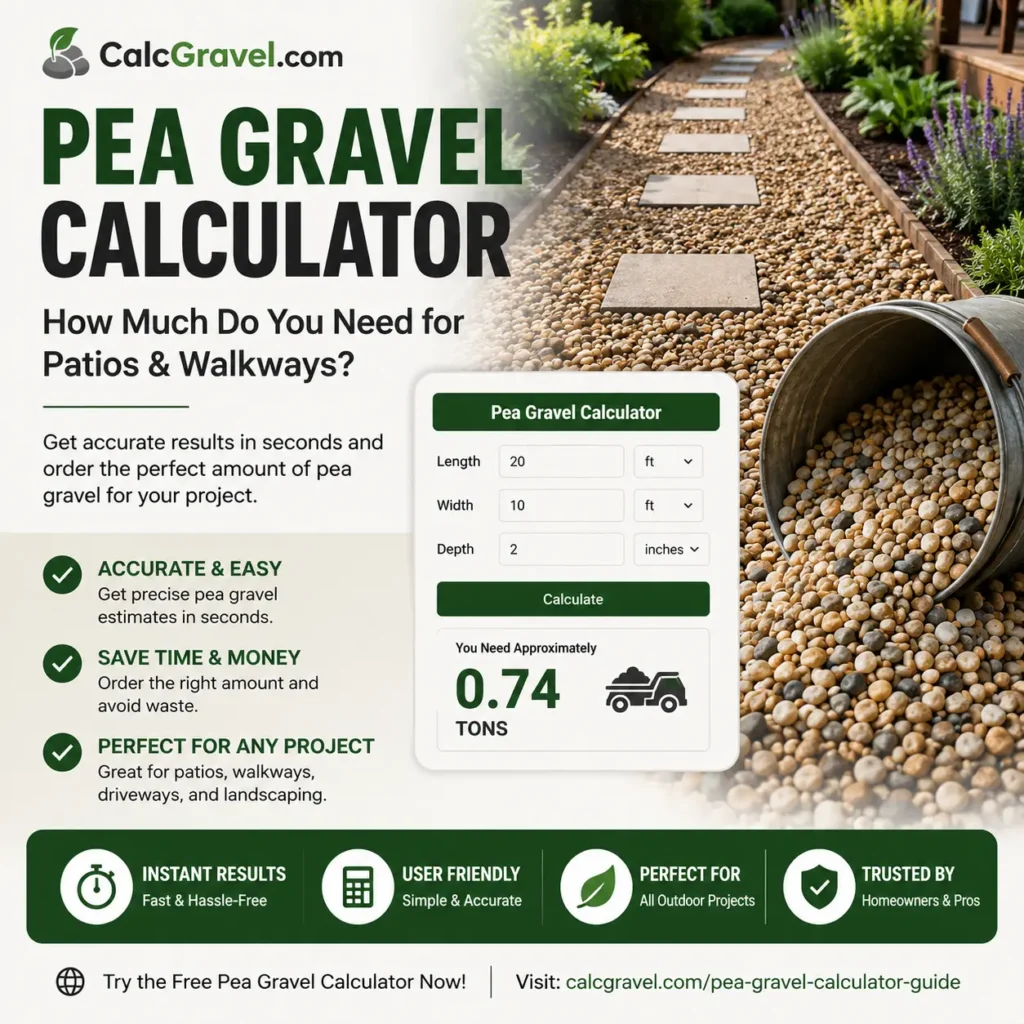
Planning a patio or walkway project? Use our free pea gravel calculator to get an instant estimate of how much material you’ll need — no guesswork required.
What Is Pea Gravel?
Pea gravel is a naturally rounded stone formed when water wears away larger rocks over time. It’s typically sourced from rivers, old lakebeds, and other locations shaped by flowing water. The name comes from its size — roughly that of a pea. Unlike crushed stone, which is machine-broken and sharp-edged, pea gravel is smooth because it has been naturally tumbled by water.
This makes it a popular choice for yards and gardens: affordable, easy to work with, and comfortable underfoot.
Size and Appearance
Pea gravel stones typically range from 1/8 inch to 3/8 inch, with some varieties reaching up to 1/2 inch. Their rounded shape means they stay loose rather than compacting together, even after installation.
Common Colors
| Color | Natural Source | Best Suited For |
| White & Cream | Limestone | Modern, minimalist designs |
| Gray & Charcoal | Granite with mica | Contemporary, industrial spaces |
| Black | Basalt | Bold, modern contrast |
| Brown & Tan | Iron-sandstone | Traditional, warm settings |
| Dyed Colors | Colored stones | Custom accent features |
Note: Dyed gravel fades after a few seasons of sun exposure. For long-lasting color, stick with natural stone.
Common Uses
Pea gravel is versatile and works well for:
- Walkways and garden paths — comfortable to walk on
- Patios and seating areas — low-maintenance, budget-friendly, drains well
- Dog runs — gentle on paws and drains urine quickly
- Playgrounds — absorbs impact and is safe for kids
- French drains — allows water to flow freely
- Decorative mulch — suppresses weeds and doesn’t decompose like wood mulch
Pea gravel is also effective for managing stormwater. As noted by the Alabama Extension’s guide on reducing runoff, a strip of pea gravel can help absorb and filter runoff.
Pro Tip: Pea gravel works best for walking surfaces. For driveways, crushed stone is a better choice since it compacts more firmly and handles vehicle weight better.
Pea Gravel Calculator: Estimate Your Project:
Enter your patio or walkway dimensions below to get an instant estimate. The pea gravel calculator gives you:
- Cubic yards — the volume you need
- Tons — the weight to order
- Cost — an estimate based on current prices
- Bags needed — if you’d rather buy in bags
How to Calculate Pea Gravel Yourself:
If you’d rather do the math by hand, here’s a simple step-by-step breakdown.
Step 1: Measure the Area:
Start by measuring the length and width of your space in feet.
- Square/rectangular area: Length × Width
- Circular area: Radius² × 3.14
- Irregular shapes: Break the space into rectangles or circles, calculate each separately, then add the totals
Example: A walkway that’s 30 feet long and 4 feet wide covers 120 square feet.
Step 2: Choose Your Depth:
Recommended depth depends on the project:
| Project Type | Recommended Depth |
| Walkways & Paths | 2–3 inches |
| Patios & Seating Areas | 3–4 inches |
| Playgrounds | 9 inches minimum (CPSC standard) |
| Garden Borders | 1.5–2 inches |
| Decorative Landscaping | 2–3 inches |
| French Drains | 8–12 inches |
Convert inches to feet by dividing by 12 (e.g., 3 inches ÷ 12 = 0.25 feet).
Step 3: Calculate Volume:
Formula: Volume (ft³) = Length × Width × Depth (in feet)
Example: 30 ft × 4 ft × 0.25 ft = 30 cubic feet
Convert to cubic yards (the unit most suppliers use) by dividing by 27:
Example: 30 ÷ 27 = 1.11 cubic yards
Quick formula: (Square Feet × Depth in Inches) ÷ 324 = Cubic Yards
Pro Tip: Order 5–10% extra to account for settling, spillage, and uneven ground.
Step 4: Convert to Weight:
Pea gravel is usually sold by the ton. Multiply cubic yards by density (1.45 tons per yard) to get the weight.
Example: 1.11 yards × 1.45 = 1.61 tons
Result: A 30×4 ft walkway at 3 inches deep needs about 1.6 tons.
Tools You’ll Need:
- Measuring tape
- Wooden stakes and string line (to mark boundaries)
- Landscape fabric (weed barrier)
- Rake or garden hoe (for spreading and leveling)
- Wheelbarrow
- Hand tamper or plate compactor (for the base layer)
Coverage Guide:
Coverage per Cubic Yard:
One cubic yard (27 cubic feet) covers:
| Depth | Coverage |
| 1 inch | ~324 sq ft |
| 2 inches | ~162 sq ft |
| 3 inches | ~108 sq ft (standard for patios) |
| 4 inches | ~81 sq ft (standard for driveways) |
Coverage per Ton:
| Depth | Coverage |
| 2 inches | ~115 sq ft |
| 3 inches | ~80 sq ft |
| 4 inches | ~60 sq ft |
Coverage per 50 lb Bag (~0.5 cu ft):
| Depth | Coverage |
| 1 inch | ~6 sq ft |
| 2 inches | ~3 sq ft |
| 3 inches | ~2 sq ft |
| 4 inches | ~1.5 sq ft |
Note: You’ll need roughly 54 bags to cover 1 cubic yard.
How Much Does Pea Gravel Cost?
Pea gravel is one of the most affordable landscaping materials available. Here’s what to expect in 2026.
Pricing by Purchase Method:
| Purchase Method | Average Cost |
| Per Bag (0.5 cu ft) | $4–$7 |
| Per Ton (Bulk) | $10–$50 |
| Per Cubic Yard (Bulk) | $45–$80 |
| Pickup from Quarry | $29–$40 per yard |
Note: One cubic yard of pea gravel weighs 1.35–1.4 tons.
Cost per Square Foot (Installed):
| Installation Type | Cost Range |
| Materials Only | $0.50–$1.50 |
| DIY (All In) | $1.00–$2.50 |
| Professionally Installed | $1.50–$4.50 |
Estimated Cost by Project:
- Walkway (4×20 ft): ~$250
- Patio (10×10 ft): $300–$550
- Single-car driveway (200 sq ft): $300–$700
- Two-car driveway (800 sq ft): $1,200–$2,800
What Affects Price:
Price varies based on gravel color and type, delivery distance, region, and season.
- Specialty gravel colors: $20–$60 per ton extra
- Delivery: $60–$150 within 15 miles, $5–$10 per mile beyond that
- Regional pricing: $20–$35/ton in the Southeast and Midwest; $35–$58/ton on the Pacific Coast and Northeast
- Buying in late fall or winter can save 15–25%
Cost-Saving Tips:
- Buying in bulk is significantly cheaper than bags for projects over 50 sq ft
- Picking up gravel yourself from a quarry saves 15–20% by avoiding delivery fees
- DIY installation saves money since labor typically makes up 40–60% of total project cost
Recommended Depth by Project Type:
Walkways & Paths
A depth of 2–3 inches is usually sufficient — deep enough for good drainage and stability, but not so deep that your feet sink in as you walk. Lightly used paths can get by with 2 inches; regularly used ones do better at 3. Add a 1-inch base layer of sand or crushed gravel underneath to keep stones from settling into the soil.
Patios & Outdoor Seating Areas:
Aim for 3–4 inches. Seating-only areas can use the lower end; patios with furniture need the full 4 inches to stay stable under weight. A compacted crushed stone base (2–4 inches) underneath prevents the surface from becoming uneven over time.
Playgrounds:
A minimum of 9 inches is required for impact absorption (per CPSC safety standards). Start with about 12 inches, since the material compacts down over time. Check depth periodically to ensure it stays at safe levels.
Garden Borders & Decorative Landscaping:
A thin layer of 1.5–2 inches works well for weed control while still showing off the stone. Lay landscape fabric underneath to block weeds, and leave a 6-inch gap around tree trunks to avoid trapping moisture against the bark.
French Drains:
Use a 2-inch base layer beneath the drainage pipe and 6–8 inches on top and around it. Wrap the entire gravel assembly in fabric to prevent soil and debris from clogging the drain.
Pea Gravel vs. Other Materials:
Vs. Crushed Stone: Pea gravel is smooth and rounded; crushed stone is angular. Crushed stone offers better stability for load-bearing uses, while pea gravel wins on comfort and looks.
Vs. Decomposed Granite (DG): DG compacts into a firmer, more stable surface but can turn muddy in wet climates. Pea gravel drains better and feels more comfortable underfoot.
Vs. River Rock: River rock is larger and better suited to slopes and erosion control. Pea gravel is better for walkable surfaces.
Vs. Organic Mulch: Mulch enriches soil as it breaks down and retains moisture better. Pea gravel lasts longer and needs less maintenance.
Vs. Interlocking Pavers: Pavers are permanent and stay level; pea gravel is loose and can shift under weight. Pavers suit high-traffic furnished areas better, while pea gravel suits casual, budget-conscious spaces.
Quick Decision Guide:
- Driveway: Crushed stone (crusher run)
- Patio with furniture: Pavers or stepping stones set into pea gravel
- Path/walkway: Pea gravel or stabilized DG
- Sloped bank: River rock
- Dog run: Pea gravel
- Flower beds: Organic mulch or pea gravel (for drought-tolerant designs)
Frequently Asked Questions:
How much pea gravel do I need for a walkway?
For a 50-foot by 3-foot walkway at 2 inches deep, you’ll need approximately 0.9 cubic yards, or about 1.3 tons. Add 10% extra for wastage and settling.
What’s the best depth for pea gravel?
It depends on use: 2–3 inches for walkways and paths, 3–4 inches for patios, 9 inches minimum for playgrounds, and 3–4 inches over a compacted base for driveways.
Can I use pea gravel for a driveway?
Yes, with precautions. You’ll need a 4–6 inch base of compacted crushed stone underneath, edging to keep the gravel contained, and possibly a stabilization grid to prevent shifting under vehicle weight.
Is pea gravel expensive?
No — it’s one of the more affordable landscaping materials, typically running $1–$3 per square foot installed. The raw material costs $25–$60 per ton, and buying in bulk from a quarry can cut costs significantly compared to bags. Budget for replacing lost material every 1–2 years due to migration or compaction.
How much does one ton of pea gravel cover?
About 115 square feet at 2 inches deep, 80 square feet at 3 inches, and 60 square feet at 4 inches.
Ready to get exact numbers for your project? Use the calculator above to generate an instant estimate based on your specific dimensions.