

Cubic Feet Calculator – Find Cubic Feet for Any Shape or Material:
Ordering the right amount of material for a project — soil, gravel, concrete, or mulch — always comes down to one number: cubic feet. Whether you’re filling a raised bed, pouring a slab, or leveling a paver patio, a reliable cubic feet calculator turns your measurements into an exact volume so you don’t overspend or run short mid-project.
This guide walks through every formula, conversion, and real-world example you need — and shows how the same math applies whether you’re working in square feet, cubic yards, or gallons.
What Is a Cubic Feet Calculator and Why You Need It
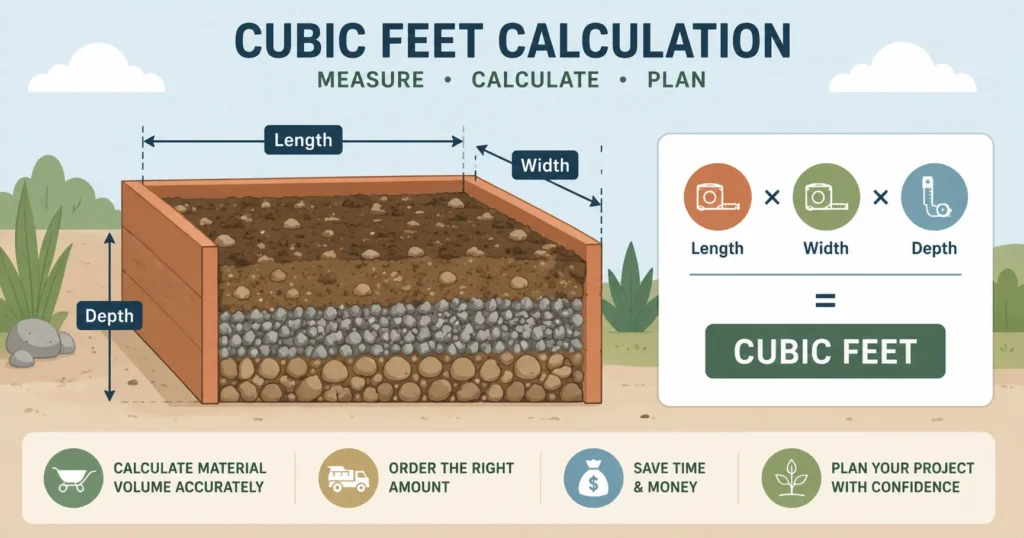
A cubic feet calculator is a tool that finds the three-dimensional volume of an object or space in cubic feet (ft³). Unlike area, which only measures a flat surface (length × width), volume adds a third dimension — depth or height — to tell you exactly how much material is needed to fill that space.
Why Accurate Volume Calculation Matters
Getting this number right protects both your budget and your project’s durability. Ordering too little concrete mid-pour, for example, creates a visible “cold joint” and a structural weak point. Ordering too much means paying for material you’ll never use. Most professionals also build in a small waste allowance — usually 5–10% for flat, even surfaces and up to 20% for irregular ground or compacted materials like gravel — since real job sites rarely match a perfect calculation. The American Concrete Institute outlines similar tolerance guidance for slab and footing pours.
Who Uses This Calculator
Contractors use it to size concrete slabs, footings, and paver bases. Landscapers rely on it to order the right volume of mulch, soil, or stone. Homeowners use it for everything from garden beds to figuring out if a piece of furniture will fit in a storage unit. Even shipping and logistics teams use cubic footage to plan cargo space.
Cubic Feet Calculator – Get Instant Results
A good calculator lets you skip manual math entirely.
Enter your measurements: length, width, and depth — in feet, inches, yards, or metric units.
Read your results: total cubic feet, the equivalent in cubic yards (divide by 27), and sometimes a bag count based on standard 2.0 or 3.0 cu ft bags.
Estimate cost: enter a price per cubic foot, yard, or bag to get an instant budget total — handy for comparing bulk delivery against bagged material.
Cubic Feet Calculator for Different Materials
The base formula stays the same across materials — area (sq ft) × depth (ft) = cubic feet — but recommended depths and waste factors shift depending on what you’re ordering.
Cubic Feet of Soil Calculator
For soil, multiply your project’s square footage by the depth in feet, then divide by 27 to get cubic yards for bulk delivery. Add a 5–10% overage for settling after the first watering. See our full soil calculator for a ready-made tool.
Calculate Cubic Feet of Soil for Raised Beds & Pots
Depth needs vary by what you’re growing: leafy greens need about 6 inches, most vegetables need 12 inches, and deep-root crops like carrots need 12–18 inches. A common raised-bed soil recipe is 60% topsoil, 30% compost, and 10% potting mix. If your total need is under 27 cubic feet (1 cubic yard), bagged soil is usually more convenient than bulk delivery.
Calculate Cubic Feet of Dirt for Excavation
Fill dirt is dense — a cubic yard weighs roughly 2,160–2,700 lbs. Because loose dirt compacts once it’s raked or driven over, add 10–15% extra to reach your target depth after settling.
Stone Calculator Square Feet
Walkway stone typically needs a 2–4 inch layer. When stone is used as a structural base under pavers, add roughly 20% extra material to account for compaction.
Rock Calculator Square Feet
One cubic yard of rock covers about 81 square feet at a 4-inch depth. As a rough weight estimate, multiply your cubic yard total by 1.4 to get US tons.
Sand Calculator Square Feet
A standard paver patio needs a 1-inch sand leveling layer over a compacted gravel base. Dry sand weighs about 100 lbs per cubic foot.
Square Feet to Cubic Feet Calculator (Area to Volume Conversion)
A square feet to cubic feet calculator converts a flat area into a usable volume by adding depth — the one ingredient area alone can’t give you.
Step-by-Step
- Find the square footage (length × width).
- Measure your depth and convert it to feet (inches ÷ 12).
- Multiply: Area (sq ft) × Depth (ft) = Cubic Feet.
How Depth Affects Your Total
Depth has an outsized effect on volume. A 120 sq ft patio at 4 inches needs about 40 cubic feet — but bump that to 6 inches and you need 60 cubic feet, a 50% jump for the same footprint. Uneven subgrades add volume too: a 2-inch dip across 200 sq ft adds over 33 extra cubic feet.
Depth Recommendations by Project
| Project Type | Recommended Depth |
|---|---|
| Patios & Sidewalks | 4 inches |
| Driveways | 4–6+ inches |
| Garage Floors | 6+ inches |
| Raised Beds | 6–18 inches |
| Mulch | 2–3 inches |
| Gravel Walkways | 2–4 inches |
| Paver Base (Gravel) | 4–6 inches |
| Paver Base (Sand) | 1 inch |
Cubic Feet to Square Feet Calculator (Reverse Conversion)
Sometimes you already know your volume — say, a delivered load of mulch — and need to know how far it will spread.
Formula: Square Feet = Cubic Feet ÷ Depth (ft)
Example: 5 cubic feet of soil spread at 3 inches (0.25 ft) covers 20 square feet (5 ÷ 0.25). If you’re starting from cubic yards, convert to cubic feet first (yards × 27), then divide by depth.
Cubic Feet to Cubic Yards Conversion
Since one cubic yard equals 27 cubic feet (3′ × 3′ × 3′), converting is simple: divide cubic feet by 27 to get yards, or multiply yards by 27 to get feet.
Square Feet to Cubic Yard Calculator — The “324 Rule”
When your area is in square feet and depth is in inches, skip the middle step:
(Square Feet × Depth in Inches) ÷ 324 = Cubic Yards
Cubic Yard to Square Feet Calculator
Formula: Square Feet = (Cubic Yards × 27) ÷ Depth (ft). One cubic yard of concrete poured 6 inches deep covers 54 square feet.
Square Feet to Cubic Yards Gravel Example
A 10′ × 20′ driveway (200 sq ft) at 4 inches: (200 × 4) ÷ 324 = 2.47 cubic yards. Since gravel compacts, round up to 3 cubic yards to avoid running short. Try our gravel calculator for instant results.
Coverage per Cubic Yard by Depth
- 1″ depth → 324 sq ft
- 2″ depth → 162 sq ft
- 3″ depth → 108 sq ft
- 4″ depth → 81 sq ft
Cubic Feet Calculator to Gallons (Volume to Liquid Conversion)
To move from solid volume to liquid capacity:
- US Gallons: Cubic Feet × 7.48
- UK Gallons: Cubic Feet × 6.23
This conversion is essential for pools, water tanks, and aquariums — one cubic foot of water also weighs about 62.4 lbs, useful when sizing equipment pads.
Cylinder Cubic Feet Calculator
Round objects — planters, post holes, tanks — use a different formula:
Volume = π × radius² × height
Radius is half the diameter, and all measurements must be in feet. A 12-inch-wide, 12-inch-deep planter (6-inch radius) holds about 0.785 cubic feet of soil. The same formula applies to sonotubes for deck posts and circular pool volumes.
Paver Calculator Square Feet (Cubic Feet for Paver Projects)
Pavers themselves are counted by square footage, but the base beneath them — gravel and sand — must be calculated by volume.
- Standard patio base: 4–6 inches of compacted gravel
- Driveway base: 6–8 inches
- Sand leveling layer: 1 inch
Because gravel compacts once raked and tamped, add about 20% extra material to reach your target finished depth. A 200 sq ft patio at 4 inches needs roughly 66.6 cubic feet (2.47 cubic yards) before that compaction overage.
Real-World Examples
Garden Bed: 12′ × 6′ = 72 sq ft, 3″ mulch → (72 × 3) ÷ 324 = 0.67 yd³, round to 1 yd³.
Circular Planter: 3-ft radius = 28.26 sq ft, 12″ soil depth → 28.26 cubic feet, just over 1 cubic yard.
Gravel Driveway: 200 sq ft, 4″ depth → 2.47 yd³, order 3 yd³ with waste factor.
Raised Bed Soil: 3′ × 6′ bed, 10″ depth → 15 cubic feet total, split roughly into topsoil, compost, and potting mix.
Common Mistakes to Avoid
Mixing units: Plugging inches directly into a feet-based formula multiplies your result by 12 — always convert first.
Ignoring depth: Square footage alone tells you nothing about volume; a 100 sq ft patio needs 50% more concrete at 6 inches than at 4 inches.
Skipping waste allowance: Add 10% for flat slabs, up to 20% for irregular or compacted materials like gravel and paver base.
Quick Reference Conversion Table
| Area (sq ft) | 3″ Depth | 4″ Depth | 6″ Depth |
|---|---|---|---|
| 100 | 25 cu ft | 33.3 cu ft | 50 cu ft |
| 200 | 50 cu ft | 66.6 cu ft | 100 cu ft |
| 500 | 125 cu ft | 166.5 cu ft | 250 cu ft |
Cubic Feet → Gallons: 1 cu ft = 7.48 US gal | 10 cu ft = 74.8 US gal | 100 cu ft = 748 US gal
Frequently Asked Questions
How do I find cubic feet without a calculator?
Measure length, width, and height in feet and multiply them together. Convert inches to feet first by dividing by 12.
What’s the formula for irregular shapes?
Split the area into simple shapes — rectangles, triangles, circles — calculate each volume separately, then add them together.
How many cubic feet are in a cubic yard?
Exactly 27 (3′ × 3′ × 3′).
How do I convert square feet to cubic feet?
Multiply the square footage by the depth in feet.
How many gallons are in 1 cubic foot?
About 7.48 US gallons, or 6.23 UK gallons.
Is a cubic foot a metric unit?
No — it’s a US/Imperial unit. The metric equivalent for volume is the cubic meter.
About This Guide
Formulas and conversion factors here follow standard geometric principles — length × width × height for rectangular volumes, and π × radius² × height for cylinders — verified against fixed constants like 27 cubic feet per cubic yard and 7.48 gallons per cubic foot. For related project math, see our Cubic Yards Calculator, Gravel Calculator, and Soil Calculator. For general technical reference, see the International Society of Automation’s unit conversion tables and the American Concrete Institute.