
Cubic Yard Calculator: Instantly Calculate Volume, Weight & Cost for Gravel, Concrete, Dirt, Sand & Stone
Last Updated 14 sep at 9:00 PM
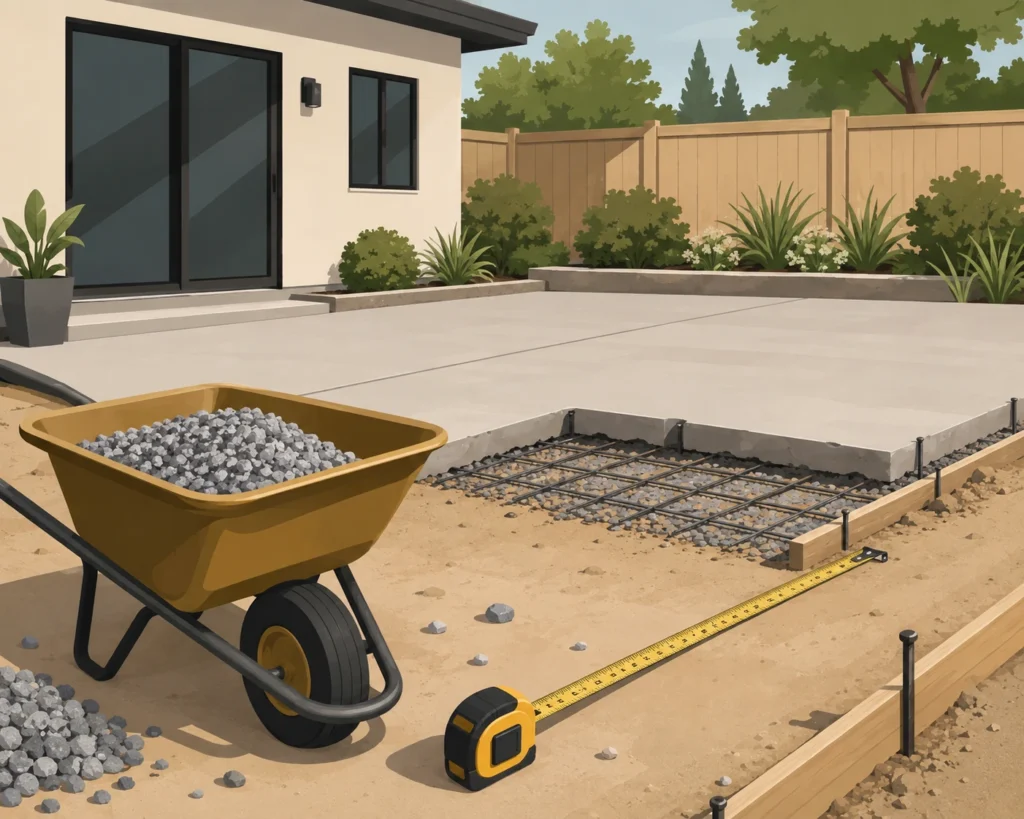
What Is a Cubic Yard? (Quick Definition)
A cubic yard is a standard unit of volume used to measure how much three-dimensional space a material occupies. It’s defined as the volume of a cube with sides measuring exactly 3 feet (1 yard) in length, width, and height. Here’s what’s worth remembering before you touch any cubic yard calculator:
- Total volume: One cubic yard equals 27 cubic feet (3′ × 3′ × 3′ = 27 ft³).
- Visual size: A cubic yard is roughly the volume of a large washing machine.
- Common uses: It’s the standard unit for pricing and delivering bulk mulch, topsoil, gravel, sand, and ready-mix concrete.
- Bag equivalent: One cubic yard equals about twenty-seven 1-cubic-foot bags, or thirteen-and-a-half 2-cubic-foot bags.
For a deeper technical definition and unit history, see the Wikipedia entry on the cubic yard. Before using a cubic yard calculator, it helps to understand this base unit clearly.
How to Use This Cubic Yard Calculator
Using a cubic yard calculator correctly comes down to three simple inputs. Get these right and the rest of the math takes care of itself.
Step 1: Choose Your Shape (Rectangle, Circle, Triangle)
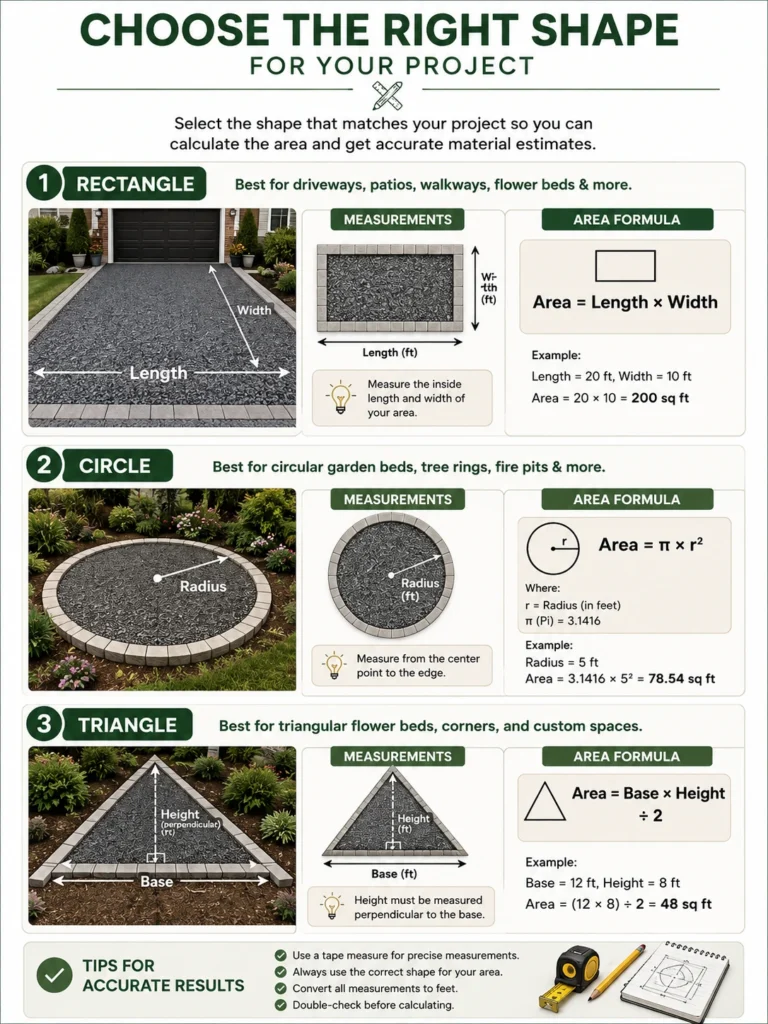
Every cubic yard calculator starts with identifying your project’s shape.
- Rectangle/Square: The most common shape — patios, driveways, rectangular garden beds.
- Circle/Round: Used for tree rings, circular flower beds, or round pillars.
- Triangle: Common for corner beds or irregular landscape features.
The first step in any volume calculation is identifying the geometric shape of your project area.
For complex, irregular layouts, break the space into smaller shapes, calculate each with the cubic yard calculator separately, and add the results together.
Step 2: Enter Length, Width & Depth
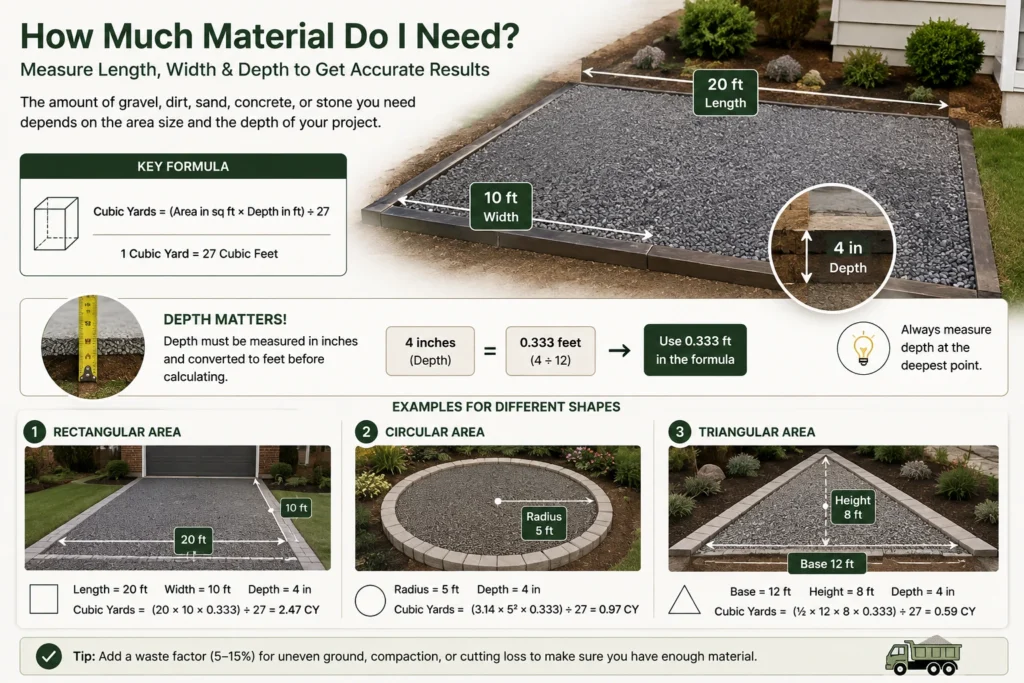
Measure the footprint of your project in feet. For circular areas, measure the diameter across the widest point. Decide your desired depth — 3 inches is common for gravel top-dressing, 4 inches for residential concrete slabs. Since most depths are measured in inches but the formula runs on feet, always divide your inch measurement by 12 to convert (e.g., 4″ ÷ 12 = 0.33 ft).
Step 3: Select Material Type & Waste Factor:
This is where the cubic yard calculator becomes especially useful — it applies the right density automatically.
Choosing your material — gravel, topsoil, sand, or concrete — lets the calculator apply the correct density for weight estimates. Never order the exact geometric volume; add a 5–10% safety margin for spillage and uneven subgrade. For materials that settle when packed, like gravel driveway bases, add 10–30% compaction allowance so the finished bed reaches the depth you actually want. Check our gravel depth guide for material-specific depth recommendations.
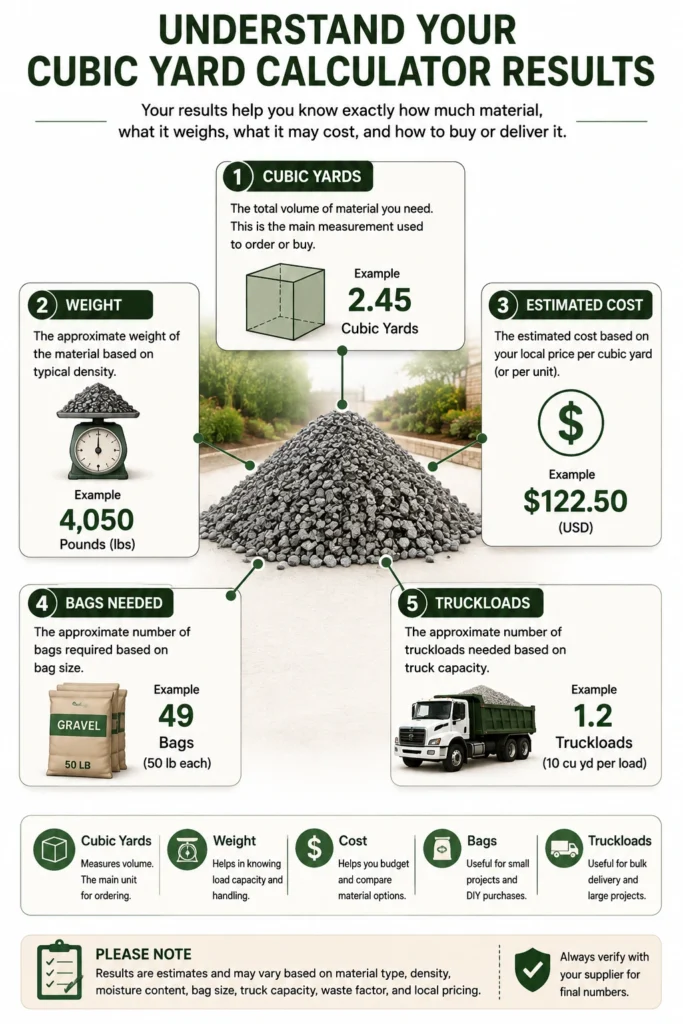
Understanding Your Results (Volume, Weight, Cost, Bags, Truckloads)
- Volume — total material to order, in cubic yards or cubic feet (1 yd³ = 27 ft³).
- Weight — estimated tons or pounds, based on standard material densities.
- Cost — total price if you enter a rate per ton or per bag.
- Bags — equivalent retail bag count for small jobs.
- Truckloads — trips needed based on standard vehicle capacity (a dump truck typically carries 10–14 cubic yards).
Once you calculate, the tool returns several critical numbers:
The Cubic Yard Formula (How to Calculate Manually):
If you prefer manual math over using a cubic yard calculator, here’s the formula behind it.
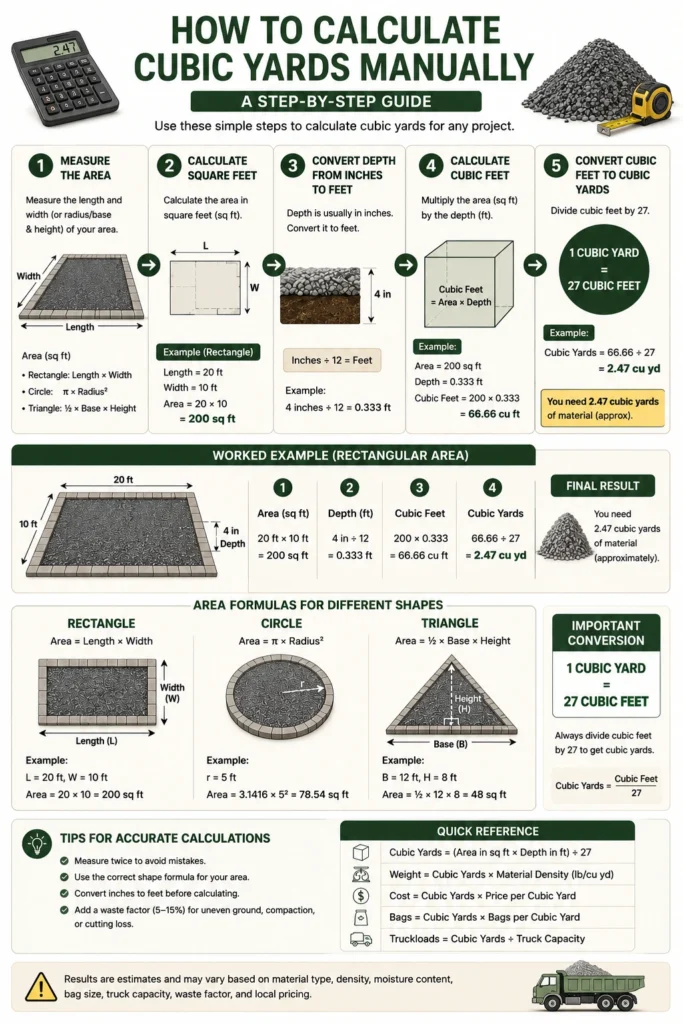
Even with a calculator handy, it helps to understand the math behind it. The universal formula is: (Length ft × Width ft × Depth ft) ÷ 27 = Cubic Yards. All measurements must be converted to feet before you multiply.
Rectangle Area Formula
For rectangular or square projects — patios, driveways, garden beds — multiply length (ft) by width (ft) to get total square footage.
Circle Area Formula
For circular spaces like tree rings or round pillars, use π × Radius², where π ≈ 3.14 and the radius is half the diameter.
Triangle Area Formula
For triangular areas, multiply 0.5 × Base × Height, measuring height perpendicular to the base.
Converting Inches of Depth to Feet
The most common manual error is mixing feet of area with inches of depth. Always divide depth in inches by 12:
- 3 inches = 0.25 ft
- 4 inches = 0.33 ft
- 6 inches = 0.50 ft
Worked Example, Step by Step:
Here’s how a cubic yard calculator arrives at this same number.
Take a 12 ft × 10 ft patio at 4 inches deep:
- Convert depth: 4 ÷ 12 = 0.333 ft
- Area: 12 × 10 = 120 sq ft
- Volume: 120 × 0.333 = 39.96 cu ft
- Cubic yards: 39.96 ÷ 27 = 1.48 yd³
- Add 10% waste factor: 1.48 × 1.10 ≈ 1.63 cubic yards to order
Square Feet to Cubic Yards Conversion:
This is one of the most common conversions a cubic yard calculator handles automatically.
How to Convert Sq Ft to Cubic Yards?
Since square feet measures area and cubic yards measures volume, you need a depth figure to bridge the two. Confirm your total square footage, convert depth to feet, multiply the two for cubic feet, then divide by 27. Quick reference for 100 sq ft:
- 2 inches → 0.62 yd³
- 3 inches → 0.93 yd³
- 4 inches → 1.23 yd³
- 6 inches → 1.85 yd³
How to Convert Square Yards to Cubic Yards
Square yards measure area; cubic yards measure volume. If your depth is already in yards, simply multiply the two. If depth is in feet or inches, convert your square yards to square feet first (multiply by 9), then apply the standard formula: square feet × depth in feet ÷ 27.
Cubic Yard Calculator by Material
The universal formula stays the same, but the final order depends heavily on each material’s weight, compaction behavior, and recommended waste factor.
Gravel & Crushed Stone Cubic Yard Calculator
A cubic yard of gravel typically weighs 2,300–2,900 lbs (about 1.4 tons). Because gravel and crushed stone have air gaps that compress under pressure, add a 10–30% compaction allowance so the bed reaches its design depth after being driven on or rolled. Use 3–4 inches for decorative paths and 4–6 inches for driveway bases, plus a 10–15% waste buffer. For a full breakdown of gravel types and depth recommendations, see our gravel depth guide and pea gravel vs crushed stone comparison.
Concrete / Cement Cubic Yard Calculator
Concrete is the heaviest common material at 3,600–4,100 lbs (about 2 tons) per cubic yard. One cubic yard equals roughly forty-five 80-lb bags, sixty 60-lb bags, or ninety 40-lb bags. Standard residential slabs run 4 inches thick; driveways for heavier loads need 5–6 inches. Always add 5–10% extra to avoid a structural “cold joint” from running short mid-pour.
Dirt & Topsoil Cubic Yard Calculator
Moist topsoil weighs 2,200–2,400 lbs per yard, while saturated or clay-heavy soil can reach 2,700–3,000 lbs. Loose soil settles 10–20% after delivery and watering, so order slightly more than the raw geometric volume. Lawns typically need 4–6 inches of topsoil; garden beds benefit from 6–12 inches for deeper root growth.
Sand Cubic Yard Calculator
Dry sand weighs roughly 2,600–3,000 lbs per cubic yard; wet sand is heavier still. Retail play-sand bags (0.5 cu ft) need about 54 bags to fill a full cubic yard. Sandboxes typically need 10–12 inches of depth, while a paver setting bed needs only about 1 inch.
Mulch & Bark Cubic Yard Calculator
Mulch is the lightest material on this list — just 400–800 lbs dry, though it can exceed 1,000 lbs wet since wood absorbs moisture. One cubic yard covers roughly 100–108 sq ft at the standard 3-inch depth, and equals about thirteen-and-a-half 2-cubic-foot bags.
Material Density & Weight Chart (Cubic Yards to Tons)
Cubic yards measure volume; tons measure weight. Because density varies by material and moisture content, the same volume can weigh drastically different amounts.
| Material | Density (tons/yd³) | Approx. lbs/yd³ |
|---|---|---|
| Concrete | 1.85–2.11 | 3,700–4,100 |
| Asphalt (hot-mix) | 1.96–2.09 | 3,920–4,180 |
| Riprap | 1.70–2.00 | 3,400–4,000 |
| Gravel (1/4″–2″) | 1.40–1.70 | 2,800–3,400 |
| Crushed Stone | 1.35–1.40 | 2,700–2,800 |
| Sand (dry) | 1.30–1.50 | 2,600–3,000 |
| Topsoil (moist) | 1.10–1.20 | 2,200–2,400 |
| Mulch (dry wood) | 0.20–0.40 | 400–800 |
Gravel Type Density Comparison (Pea Gravel, Crushed Stone, River Rock, Decomposed Granite, Limestone, Crusher Run, Rip Rap)
- Pea Gravel (3/8″): ~1.40 tons/yd³ (2,830 lbs)
- Crushed Stone (3/4″ #57): ~1.35 tons/yd³ (2,700 lbs)
- River Rock (1″–3″): ~1.27 tons/yd³ (2,530 lbs)
- Decomposed Granite: ~1.35 tons/yd³ (2,700 lbs)
- Crusher Run / Road Base: ~1.48 tons/yd³ (2,950 lbs)
- Riprap: 1.70–2.00 tons/yd³
How Much Does a Cubic Yard of Gravel/Concrete/Dirt Weigh?
Concrete tops the list at roughly 4,000 lbs (2 tons) per yard. Standard dry gravel runs 2,700–2,900 lbs (1.35–1.45 tons). Moist topsoil averages around 2,200 lbs (1.1 tons), rising to 2,700–3,000 lbs when saturated or clay-heavy.
How to Convert Cubic Yards to Tons
Formula: Tons = Cubic Yards × Density (tons/yd³). Example: 7 cubic yards of gravel at 1.4 tons/yd³ density → 7 × 1.4 = 9.8 tons. For high-accuracy jobs, add a 10–30% compaction allowance to your volume before converting to weight.
Depth Reference Charts (Per 100 Sq Ft)
Gravel Depth Chart (2″, 3″, 4″, 6″)
| Depth | Cubic Yards per 100 Sq Ft | Typical Use |
|---|---|---|
| 2″ | 0.62 yd³ | Decorative refresh, bedding sand |
| 3″ | 0.93 yd³ | Walking paths, decorative rock |
| 4″ | 1.23 yd³ | Paver base, small paths |
| 6″ | 1.85 yd³ | Driveway base, deep drainage |
Add a 10–15% waste factor for gravel projects to cover compaction and uneven subgrade — see our guide to laying a gravel driveway for a full walkthrough.
Topsoil Depth Chart (4″, 6″, 12″)
| Depth | Cubic Yards per 100 Sq Ft | Typical Use |
|---|---|---|
| 4″ | 1.23 yd³ | New lawn/sod |
| 6″ | 1.85 yd³ | Garden beds, shrub prep |
| 12″ | 3.70 yd³ | Raised beds, deep fill |
Concrete Slab Depth Chart (4″, 6″)
| Depth | Cubic Yards per 100 Sq Ft | Typical Use |
|---|---|---|
| 4″ | 1.23 yd³ | Patios, sidewalks, garage floors |
| 6″ | 1.85 yd³ | Driveways, equipment pads |
Cost Estimation: Price Per Ton, Per Bag & Total Project Cost
Average Cost Per Ton by Material
- Concrete: $125–$200 per cubic yard; $6.50–$10.50/sq ft installed.
- Gravel & Stone: $31/yard for pea gravel up to $80+ for specialty granite; crushed stone averages ~$40/ton. See current rates in our gravel cost per ton guide.
- Topsoil & Loam: $33–$35 per cubic yard; premium loam up to $55/yard.
- Mulch: ~$36 per cubic yard in bulk — bagged mulch runs 2–3x more expensive.
Bags Needed by Bag Size (40lb, 50lb, 80lb)
| Bag Weight | Mixed Yield | Bags per Cubic Yard |
|---|---|---|
| 40 lb | 0.30 cu ft | 90 bags |
| 50 lb | 0.375 cu ft | 72 bags |
| 60 lb | 0.45 cu ft | 60 bags |
| 80 lb | 0.60 cu ft | 45 bags |
Cubic Yards to Bags Conversion
Mulch: one cubic yard = thirteen-and-a-half 2-cu-ft bags or nine 3-cu-ft bags. Soil and sand: one cubic yard = twenty-seven 1-cu-ft bags or fifty-four 0.5-cu-ft bags. If your job needs fewer than 8–10 bags, buying bagged material is usually more convenient than a bulk order.
How Many Cubic Yards Fit in a Truckload?
Pickup trucks physically hold 2–3 cubic yards of light material like mulch, but a half-ton pickup hits its weight limit at roughly 1 cubic yard of gravel or concrete. Standard dump trucks carry 10–14 cubic yards per trip, and ready-mix concrete trucks typically deliver 8–12 cubic yards.
Real Project Examples
Gravel Driveway (12×60 ft, 4″ Base + 2″ Top)
Base layer: (12 × 60 × 0.333) ÷ 27 = 8.88 yd³ → with 20% compaction/waste ≈ 10.66 yd³. Top layer: (12 × 60 × 0.167) ÷ 27 = 4.45 yd³ → with 10% waste ≈ 4.9 yd³. Total order: roughly 15.5–16 cubic yards, weighing about 22 tons at 1.4 tons/yd³.
Gravel Walking Path (40 ft Long, 3″ Deep)
Assuming a 3 ft width: 40 × 3 = 120 sq ft. (120 × 0.25) ÷ 27 = 1.11 yd³ → with 15% buffer ≈ 1.3 cubic yards, or about 71 bags at 0.5 cu ft each.
Concrete Patio Slab (12×20 ft, 4″ Thick)
(12 × 20 × 0.333) ÷ 27 = 2.96 yd³ → with 10% waste ≈ 3.26 yd³, rounded to 3.25–3.5 cubic yards, weighing 6.5–7 tons.
Raised Garden Bed Topsoil (4×8 ft, 12″ Deep)
(4 × 8 × 1) ÷ 27 = 1.19 yd³ → with 15% settling buffer ≈ 1.37 yd³, rounded to 1.5 cubic yards, or roughly 38–40 bags.
Why You Should Always Add a Waste Factor
Ordering the exact calculated volume almost always leaves you short on-site. Uneven subgrade, form bulging, spillage, and simple measurement error all eat into your material supply. Running out mid-pour on concrete can create a structural “cold joint” — a permanent weak point. Most professionals recommend 5–10% extra for concrete and 10–15% extra for landscaping materials like gravel, mulch, and soil.
Bulk vs. Bagged Material: Which Should You Order?
Bulk delivery is almost always cheaper once your project needs a full cubic yard or more — bagged material can cost 2–5x more per cubic foot. Bags make sense for small jobs under 8–10 bags, or where a truck can’t access the site. One cubic yard equals about thirteen-and-a-half 2-cu-ft bags or forty-five 80-lb bags of concrete.
Common Mistakes When Calculating Cubic Yards
Forgetting to Convert Depth to Feet
Mixing feet of area with inches of depth is the single most common error — it can inflate your result by 12x. Always divide inches by 12 first.
Skipping the Waste Factor
Theoretical math assumes perfectly flat, rigid job sites, which don’t exist in practice. Round your order up to the nearest quarter-yard or full bag.
Using the Wrong Material Density
A cubic yard of concrete weighs about 4,000 lbs, while dry mulch may weigh just 400–800 lbs. Moisture content changes weight significantly, which matters for vehicle payload limits.
Miscalculating Irregular or Sloped Areas
For sloped projects, average the shallowest and deepest points to get a reliable thickness. For irregular beds, break the space into rectangles, circles, and triangles, calculate each, and sum the results.
How to Measure Irregular or Odd-Shaped Areas
Divide the space into simpler shapes and total their areas individually. For curved beds, sketch a rectangle around the curve to approximate square footage, or “balance” covered vs. uncovered space along the curve. For sloped ground, use average thickness. For tapering areas — like a driveway wider at one end — use the average width to simplify into a rectangle.
Frequently Asked Questions:
Still have questions about cubic yard calculations? Here are quick answers to the most common questions homeowners and contractors ask before ordering material.
-
How many cubic feet are in a cubic yard?
Exactly 27 cubic feet (3′ × 3′ × 3′).
-
How much does a cubic yard of gravel weigh?
Typically 2,700–2,900 lbs (1.35–1.45 tons), depending on the gravel type.
-
How much does a cubic yard of concrete weigh?
Roughly 3,700–4,100 lbs, or about 2 tons.
-
How many bags of gravel/concrete equal a cubic yard?
Concrete: ~45 bags of 80 lb, 60 bags of 60 lb, or 90 bags of 40 lb. Gravel/stone: ~54 bags at 0.5 cu ft each.
-
How many cubic yards do I need for my project?
Multiply length × width × depth (all in feet) and divide by 27. Convert inches to feet first, then round up and add a waste factor.
-
How many cubic yards fit in a dump truck?
Standard tandem dump trucks carry 10–14 cubic yards; residential delivery trucks often cap at 6 cubic yards; pickups top out around 1 cubic yard for heavy material.
-
Should I order material by the yard or in bags?
Bulk once you need a full cubic yard or more — it’s 2–5x cheaper. Bags work for small jobs under 8–10 bags.
-
How much extra should I order for waste?
5–10% for concrete; 10–15% for gravel, mulch, and topsoil; up to 20–30% for compacted gravel driveway bases.
Conclusion
Mastering cubic yard calculations is the foundation of any successful landscaping or construction project. By using the universal formula — (Length × Width × Depth) ÷ 27 — and consistently converting all measurements to feet first, you avoid the most common ordering mistakes. Always build in a waste factor, double-check your material’s density before converting to weight, and lean on bulk delivery once your project crosses the one-cubic-yard mark. Use the cubic yard calculator above to run your own numbers instantly, and check our gravel guides hub for material-specific breakdowns, or our cubic feet calculator if you need results in a different unit.
Ready to buy? See our complete guide on where to buy gravel near you — landscape yards, quarries, and delivery options compared.