

Pea Gravel vs Crushed Stone: Which is Better for Your Project?
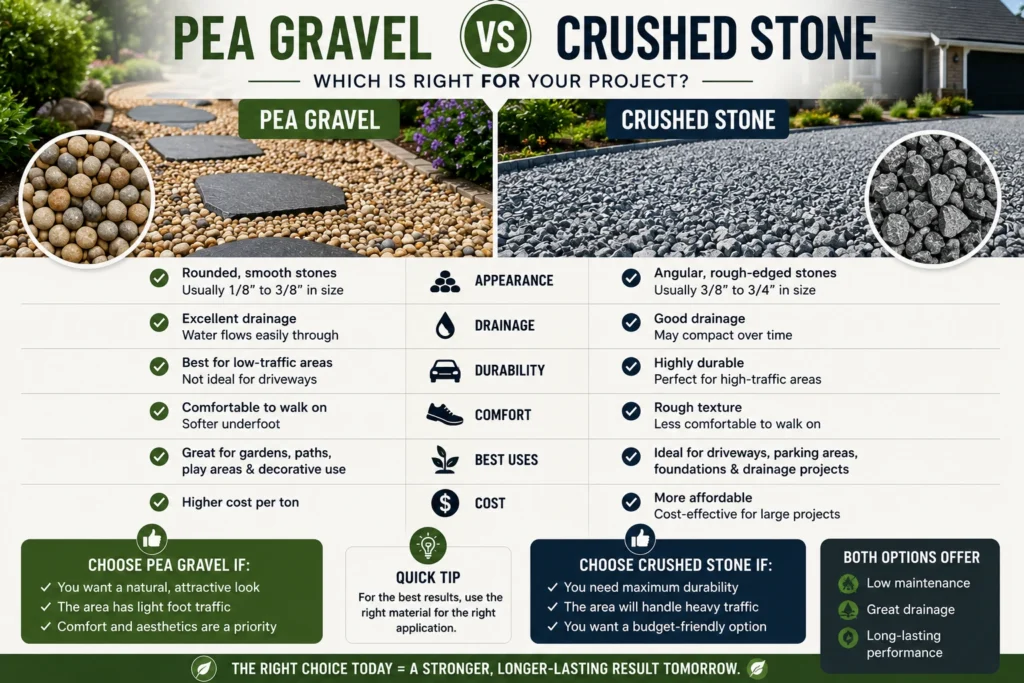
Choosing between pea gravel and crushed stone for your driveway, walkway, or landscaping project? This comprehensive comparison covers appearance, cost, durability, and best uses — so you can make the right decision. This pea gravel vs crushed stone comparison covers everything you need to know.
Introduction
Choosing the right material for your project can be overwhelming. Two of the most popular options are pea gravel and crushed stone. Both are versatile, affordable, and widely available — but they serve very different purposes.
Pea gravel offers a smooth, rounded, and decorative finish — perfect for walkways, playgrounds, and garden paths. Crushed stone provides angular, interlocking edges that create a stable, durable surface — ideal for driveways, road bases, and high-traffic areas.
The wrong choice can lead to costly mistakes: pea gravel on a driveway will shift and rut under vehicle weight, while crushed stone on a playground can be uncomfortable underfoot.
Before you decide, use our free gravel calculator to estimate exactly how much material you need for your project. This gravel estimator gives you instant results in cubic yards, tons, and total cost — so you can compare costs side by side.
What is Pea Gravel?
Pea gravel is a small, rounded, naturally weathered stone that gets its name from its size — roughly the size of a pea (¼ to ½ inch or 6-13mm).
Pea Gravel Key Characteristics
| Characteristic | Details |
|---|---|
| Size | ¼ to ½ inch (6-13 mm) |
| Shape | Smooth, rounded edges |
| Color | Available in shades of brown, tan, white, gray, and multi-color blends |
| Texture | Smooth and comfortable underfoot |
| Density | ~1.45 tons per cubic yard |
| Weight | 2,700–2,900 lbs per cubic yard |
Best Uses for Pea Gravel
- ✅ Walkways and garden paths
- ✅ Decorative landscaping and flower beds
- ✅ Playgrounds and children’s play areas
- ✅ Around water features and ponds
- ✅ Dog runs and pet areas
- ✅ Drainage and French drains (when clean)
- As explained in this pea gravel vs crushed stone guide, pea gravel is best for decorative projects.
Pea Gravel Pros and Cons
| Pros | Cons |
|---|---|
| Soft, comfortable underfoot | Not stable under vehicle weight |
| Decorative, aesthetic appeal | Shifts and moves easily |
| Easy to spread and level | Difficult to compact |
| Affordable | Can be tracked into homes |
| Good drainage | Not ideal for slopes |
What is Crushed Stone?
Crushed stone is a man-made material created by crushing larger rocks into angular pieces. The sharp, interlocking edges create a stable, load-bearing surface that compacts well.
Crushed Stone Key Characteristics
| Characteristic | Details |
|---|---|
| Size | ¾ to 1 inch (19-25 mm) and other sizes |
| Shape | Angular, sharp edges |
| Color | Typically gray, white, or tan based on source rock |
| Texture | Rough, sharp, and gritty |
| Density | ~1.60 tons per cubic yard |
| Weight | ~2,900 lbs per cubic yard |
Best Uses for Crushed Stone
- ✅ Driveways and parking areas
- ✅ Road bases and construction foundations
- ✅ High-load areas and commercial projects
- ✅ French drains and drainage systems
- ✅ Retaining wall backfill
- ✅ Sub-base for patios and pavers
- ✅ Shed bases and garage floors
- According to this pea gravel vs crushed stone guide, crushed stone is best for driveways.
Crushed Stone Pros and Cons:
This pea gravel vs crushed stone comparison helps you choose the right choice.
| Pros | Cons |
|---|---|
| Excellent compaction and stability | Sharp edges can be uncomfortable underfoot |
| Handles vehicle traffic well | Less decorative than pea gravel |
| Low maintenance | Can be more expensive |
| Interlocking edges resist shifting | Dust can be an issue |
| Good drainage | Requires compaction for best results |
Quick Comparison: Pea Gravel vs Crushed Stone
| Feature | Pea Gravel | Crushed Stone |
|---|---|---|
| Shape | Rounded, smooth | Angular, sharp |
| Compaction | Poor — doesn’t lock together | Excellent — interlocking edges |
| Stability | Shifts under weight | Stable, load-bearing |
| Underfoot Comfort | Very comfortable | Uncomfortable, sharp |
| Drainage | Excellent | Good to excellent |
| Maintenance | Requires regular raking | Low maintenance |
| Cost | $25–$53 per ton | $10–$50 per ton |
| Best Use | Walkways, landscaping | Driveways, base material |
| Appearance | Decorative, natural | Industrial, utilitarian |
| Color Options | Wide variety | Limited |
Refer to this pea gravel vs crushed stone guide for accurate material selection.
Detailed Comparison: Pea Gravel vs Crushed Stone
1. Appearance and Aesthetic
Pea gravel has a soft, natural, and inviting look. Its rounded stones come in various colors — from warm earth tones to bright whites and grays. It creates a polished, decorative finish perfect for gardens and pathways.
Crushed stone has a more rugged, industrial appearance. Its angular, sharp edges give it a utilitarian look. While less decorative than pea gravel, crushed stone can still add a modern, minimalist aesthetic to driveways and patios.
Winner: Pea gravel (for decorative projects)
2. Durability and Stability
Pea gravel moves and shifts under pressure. Its rounded edges don’t interlock, so it doesn’t compact well. Under vehicle weight, it creates ruts and requires frequent raking and topping up.
Crushed stone is highly durable and stable. The angular edges interlock when compacted, creating a solid, load-bearing surface that resists shifting. It handles heavy vehicle traffic with ease.
Winner: Crushed stone (for durability and stability)
Durability is a key factor in the pea gravel vs crushed stone decision.
3. Cost Comparison
| Material | Cost Per Ton | Cost Per Cubic Yard |
|---|---|---|
| Pea Gravel | $25 – $53 | $40 – $80 |
| Crushed Stone | $10 – $50 | $20 – $70 |
Pea gravel is generally slightly more expensive due to its decorative nature and processing requirements.
Crushed stone is typically cheaper, especially in bulk. However, costs vary based on location, type, and delivery.
Winner: Crushed stone (cheaper per ton)
Use our gravel cost estimator to calculate exact costs for your specific project. This gravel price calculator gives you accurate estimates based on material type and quantity.
Cost plays a major role in the pea gravel vs crushed stone choice.
4. Best Use Cases
| Project Type | Recommended Material | Why |
|---|---|---|
| Driveway | Crushed Stone | Interlocking edges resist vehicle weight |
| Walkway | Pea Gravel | Comfortable underfoot, decorative |
| Patio Base | Crushed Stone | Stable foundation |
| Playground | Pea Gravel | Soft, safe for children |
| French Drain | Crushed Stone (clean) | Allows water to flow freely |
| Garden Path | Pea Gravel | Natural, aesthetic look |
| Retaining Wall Backfill | Crushed Stone | Good drainage, stable |
| Decorative Landscaping | Pea Gravel | Wide color variety |
This pea gravel vs crushed stone guide highlights the best use cases for each material. For more detailed landscaping advice, visit The Spruce’s guide on choosing landscape rocks
5. Installation and Maintenance
Pea Gravel Installation:
- Excavate area to desired depth (2-3 inches)
- Lay weed membrane if needed
- Spread gravel evenly
- Rake to level
- Maintenance: Regular raking, occasional topping up
Crushed Stone Installation:
- Excavate area to desired depth (4-8 inches)
- Lay geotextile membrane
- Add and spread crushed stone in layers
- Compact each layer with a plate compactor
- Maintenance: Low maintenance, occasional top ups
Winner: Crushed stone (lower maintenance once compacted)
6. Drainage and Environmental Impact
Both materials offer excellent drainage — better than concrete or asphalt. Water flows through the gaps between stones, naturally filtering into the ground below.
Pea gravel has slightly larger gaps between rounded stones, allowing water to flow freely.
Crushed stone also drains well, though angular stones may compact more tightly, reducing drainage slightly.
Environmental Consideration: Both materials are natural and eco-friendly. Neither produces harmful runoff or pollutants. Pea gravel is often locally sourced, reducing transport emissions.
Winner: Tie (both are eco-friendly and drain well)
7. Safety Considerations
Pea gravel:
- ✅ Comfortable to walk on
- ✅ Safe for children’s play areas
- ❌ Can be a slipping hazard on slopes
- ❌ Can be tracked into homes
Crushed stone:
- ✅ Stable underfoot when compacted
- ❌ Sharp edges can be uncomfortable on bare feet
- ❌ Dust can be an issue
Winner: Pea gravel (for pedestrian safety and comfort)
In the pea gravel vs crushed stone debate, appearance is often the first consideration.
Which Should You Choose? Decision Guide:
Here’s a quick decision guide for your pea gravel vs crushed stone choice.
Choose Pea Gravel If…
- You’re creating a walkway, garden path, or decorative area
- Children or pets will use the area
- Appearance and comfort matter most
- You want a soft, natural look
- Vehicle traffic is not a concern
Choose Crushed Stone If…
- You’re building a driveway or parking area
- The area will see heavy vehicle traffic
- You need a stable, load-bearing surface
- Long-term durability is a priority
- You’re creating a sub-base for other projects
Still Not Sure?
Use our free gravel cubic to tons calculator to estimate costs and quantities for both materials. This gravel estimator helps you compare total project costs side by side, so you can make an informed decision. This pea gravel vs crushed stone guide helps you make the right decision.
Frequently Asked Questions About Pea Gravel vs Crushed Stone:
Which is better for a driveway: pea gravel or crushed stone?
Crushed stone is better for driveways. Its angular edges interlock when compacted, creating a stable surface that resists shifting under vehicle weight. Pea gravel’s rounded stones shift and rut under pressure, making it unsuitable for vehicle traffic.
Can you mix pea gravel and crushed stone?
Yes, but it’s not recommended. Mixing the two reduces the benefits of both. The rounded pea gravel prevents the crushed stone from compacting properly, compromising stability. Use one or the other for best results.
Which is cheaper: pea gravel or crushed stone?
Crushed stone is generally cheaper, ranging from $10-$50 per ton. Pea gravel costs $25-$53 per ton. However, prices vary by location, type, and quantity. Use our gravel price calculator for exact estimates.
How much pea gravel do I need for a walkway?
For a 50-foot-long, 3-foot-wide walkway at 2 inches deep, you’ll need approximately 0.9 cubic yards or 1.3 tons of pea gravel. Use our gravel calculator to get exact estimates for your specific project.
How much crushed stone do I need for a driveway?
For a 24×24-foot driveway at 4 inches deep, you’ll need approximately 7.1 cubic yards or 11.4 tons of crushed stone. Use our gravel quantity calculator for precise estimates.
Which is better for drainage: pea gravel or crushed stone?
Both are excellent for drainage. Pea gravel has slightly larger gaps between stones, allowing water to flow freely. Crushed stone also drains well, though angular stones may compact more tightly. For French drains, use clean crushed stone for optimal water flow.
Can I use pea gravel under a deck or shed?
Not recommended. Pea gravel shifts under pressure and doesn’t provide a stable base. Use crushed stone or compacted gravel instead. For sheds, consider concrete or concrete pavers for a solid foundation.
Which is better for a patio base: pea gravel or crushed stone?
Crushed stone is better for patio bases. The angular edges interlock and compact to create a stable, load-bearing surface. Pea gravel shifts under weight and doesn’t compact well, leading to an unstable patio.
Is pea gravel comfortable to walk on barefoot?
Yes! Pea gravel’s smooth, rounded stones are comfortable underfoot, making it ideal for walkways, gardens, and playgrounds. Crushed stone has sharp edges that can be uncomfortable on bare feet.
Which is better for landscaping?
Pea gravel is better for landscaping due to its decorative appearance and wide color variety. Crushed stone has a more utilitarian look and is best for functional rather than decorative projects.
Related Tools & Resources
- Gravel Calculator — Get exact estimates for your project
- Gravel Cost Per Ton Guide — Complete pricing breakdown
- Gravel Depth Guide — How deep should you go for every project?
- How to Lay a Gravel Driveway — Step-by-step installation guide
- French Drain Installation Guide — Step-by-step drainage solution
Use Our Free Gravel Calculator
Planning your project? Use our free gravel calculator to estimate exactly how much pea gravel, crushed stone, or any other material you need. This online gravel estimator gives you instant results in cubic yards, tons, and total cost.
Simply enter your dimensions, select gravel type, add waste factor, and get accurate estimates in seconds. Plan your project with confidence and order the right amount every time. Bookmark this pea gravel vs crushed stone guide for your next project.
With over 30 years in landscaping and construction, Kevin Kearney knows a thing or two about gravel. He’s helped hundreds of homeowners pick the right materials — and avoid costly mistakes.
Now he’s putting that experience into the free gravel calculator, so you can get accurate estimates without the headache.
With over 30 years in landscaping and construction, Kevin Kearney knows a thing or two about gravel. He’s helped hundreds of homeowners pick the right materials — and avoid costly mistakes.
Now he’s putting that experience into the free gravel calculator, so you can get accurate estimates without the headache.
📅 Last Updated: August 2026