
Crusher Run & Road Base: 2026 Cost, Sizes, and Buying Guide
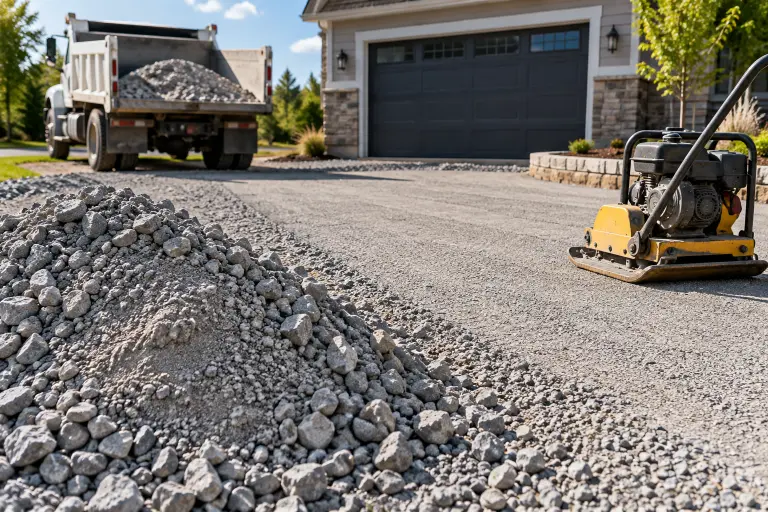
Crusher run and road base are the same job: a compactable stone base under driveways, patios, and sheds. Prices run $24–$60 per ton depending on region and supplier. This guide covers real 2026 pricing, size grades, depth, and where to buy it.
What Is Crusher Run (Road Base)?
Crusher run is crushed stone mixed with stone dust in one continuous size range, from roughly ¾-inch rock down to fine powder. The dust fills the gaps between the larger rock, so the material locks together tight when compacted.
It goes by several names depending on the supplier: road base, quarry process (QP), #411 gravel, aggregate base (AB), or 3/4-inch minus. They’re the same product family — ask for “crusher run” or “road base” and any quarry will know what you mean. Crushed stone is produced at active quarries in nearly every U.S. state, per NSSGA production data, which is why local pickup is usually cheaper than delivery from further away.
Crusher Run Cost Per Ton and Per Yard (2026)
Material-only pricing varies by supplier and region. Delivery and installation add to the base price shown below.
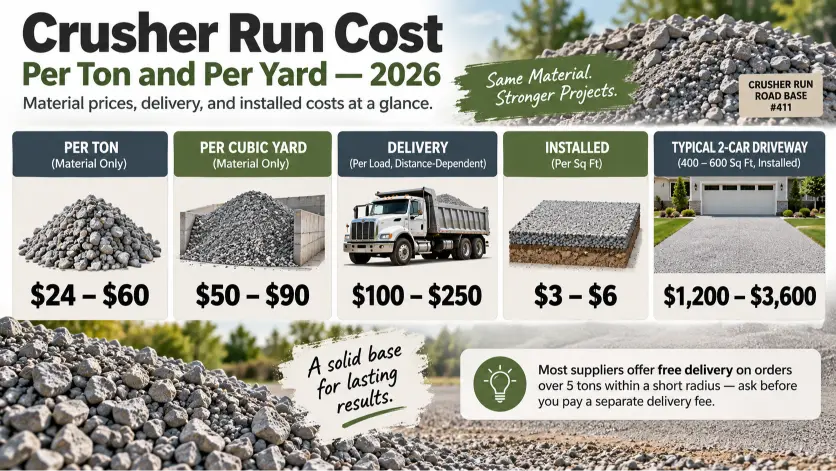
| Cost Type | Low End | High End |
|---|---|---|
| Per ton (material only) | $24 | $60 |
| Per cubic yard (material only) | $50 | $90 |
| Delivery (per load, distance-dependent) | $100 | $250 |
| Installed, per sq ft (material + delivery + labor) | $3 | $6 |
| Typical 2-car driveway (400–600 sq ft), installed | $1,200 | $3,600 |
Most suppliers offer free delivery on orders over 5 tons within a short radius — ask before you pay a separate delivery fee. Stone-rich regions tend to sit at the low end of this range; areas that truck material in from further away run higher, a pattern also reflected in HomeGuide’s 2026 gravel pricing data.
Need the cost for regular gravel instead of crusher run? See our full gravel cost per ton guide for a broader material-by-material breakdown.
Crusher Run Sizes and Grades
Crusher run comes in a few top-size grades. Picking the right one depends on what’s going on top of it.
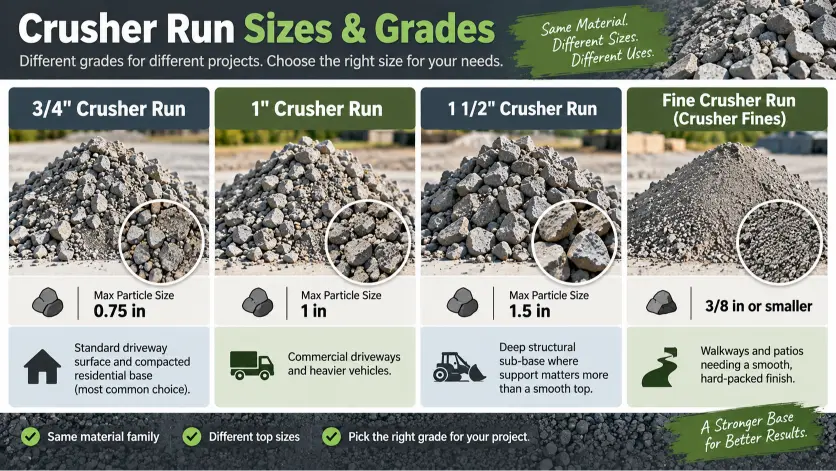
| Grade | Max Particle Size | Best For |
|---|---|---|
| 3/4″ crusher run | 0.75 in | Standard driveway surface & compacted base (most common residential choice) |
| 1″ crusher run | 1 in | Base layer for commercial driveways, heavier vehicles |
| 1 1/2″ crusher run | 1.5 in | Deep sub-base where structural support matters more than a smooth top |
| Fine crusher run (crusher fines) | 3/8 in or smaller | Walkways and patios needing a smooth, hard-packed finish |
Finer grades compact tighter and pack down harder, since the small particles fill the gaps left by bigger ones. Coarser grades need more compaction passes but hold up better under heavy structural loads.
Crusher Run vs. #57 Stone: Which One Do You Need?
These two get confused constantly because they’re sold at the same yards. The difference comes down to drainage.
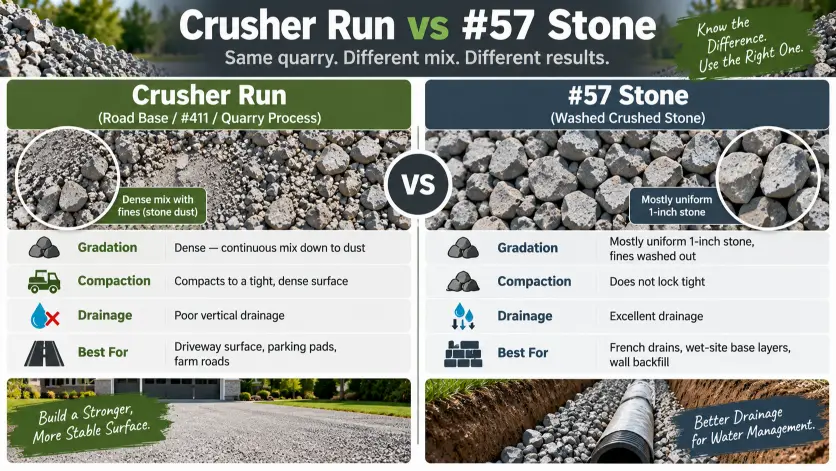
| Feature | Crusher Run | #57 Stone |
|---|---|---|
| Gradation | Dense — continuous mix down to dust | Open — mostly uniform 1-inch stone, fines washed out |
| Compaction | Compacts to a tight, dense surface | Does not lock tight — stones can shift underfoot |
| Drainage | Poor vertical drainage; water sheds off the surface | Excellent — water moves freely through open voids |
| Typical use | Driveway surface, parking pads, farm roads | French drains, wet-site base layers, wall backfill |
If your project needs water to pass through — a French drain, for example — #57 stone is the right call, not crusher run. For a driveway surface you’ll walk and drive on, crusher run’s tighter compaction wins. See Komplet America’s contractor reference guide for the full engineering breakdown.
How Deep Should Crusher Run Be?
Depth depends on what’s driving or sitting on top of it.
| Project | Recommended Depth |
|---|---|
| Standard driveway (cars, light trucks) | 4–6 inches, compacted |
| Heavy-vehicle driveway (RVs, commercial trucks) | 8–12 inches, compacted |
| Patio or walkway base | 4–6 inches |
| Under pavers | 4–6 inches of crusher run, plus a 1-inch bedding-sand layer on top |
Pavers can’t sit directly on crusher run — they need that bedding-sand layer for a level surface. Skipping it is one of the most common paver-settlement complaints we see referenced in contractor forums.
For general gravel depth guidance across other project types, see our gravel depth guide.
How Much Crusher Run Do I Need?
Crusher run is sold by the ton, but you plan projects by area and depth. Work out cubic yards first, then convert:
Cubic yards = (length ft × width ft × depth in inches ÷ 12) ÷ 27
Tons = cubic yards × 1.4 to 1.5 (crusher run’s compacted density)
Use our yards-to-tons calculator to convert your volume once you know it, or start from square footage with the main gravel calculator. Order 5–10% extra — running short mid-project is the single most common complaint in DIY installation threads.
Where to Buy Crusher Run or Road Base Near You
Crusher run is a quarry product, not a bagged retail item, so pricing and availability are local. Landscape supply yards and quarries carry it in bulk at the lowest price; home improvement stores sell small bagged amounts at a much higher per-ton cost.
See our full local buying guide for a supplier-by-supplier comparison, including bulk-vs-bagged pricing.
Frequently Asked Questions
Is road base the same thing as crusher run?
Yes. “Road base,” “quarry process,” “#411 gravel,” and “3/4-inch minus” are regional names for the same dense-graded crushed stone product.
How thick should a crusher run base be for a driveway?
4–6 inches, compacted, for a standard car driveway. Heavy vehicles like RVs need 8–12 inches.
Can I put pavers directly on crusher run?
No. Add a 1-inch layer of coarse bedding sand on top of the compacted crusher run before setting pavers.
Will weeds grow through crusher run?
A well-compacted layer resists most weeds, but persistent ones can eventually push through over time. A geotextile fabric layer underneath gives longer-term prevention.
How much does a truckload of crusher run cost?
A typical delivered load (5+ tons) runs $100–$250 for delivery on top of the $24–$60-per-ton material cost, depending on distance from the quarry.
Do I need geotextile fabric under crusher run?
It’s not required, but it’s recommended on soft or clay soil — it stops the base from sinking into the ground over time and adds weed resistance.