

Pea Gravel Guide: Cost, Size, Coverage & Calculator
Written by CalcGravel team · Last updated: November 1, 2026 · Prices checked November 2026 · How we researched this
Quick answer
Pea gravel costs about $30 to $55 per ton for the stone (roughly $40 to $75 per cubic yard), plus $60 to $250 for delivery. One cubic yard weighs about 1.35 tons (2,700 lb) and covers about 108 square feet at 3 inches deep. Use the calculator below, then add 10 percent for settling.
Planning a patio, walkway or dog run? This pea gravel guide covers the price per ton and per yard, size, weight, coverage, best uses, pros and cons, and the right depth for each project. Every figure comes from one set of numbers, so the calculator and the tables always agree.
What Is Pea Gravel?
Pea gravel is a naturally rounded stone, usually 1/8 to 3/8 inch across, that water has tumbled smooth in rivers, creeks and old lakebeds. It is named for its size, close to a garden pea, and is similar to the #8 stone gradation (about 3/8 inch). Unlike crushed stone, which is machine-broken and sharp-edged, pea gravel is smooth underfoot and drains freely.
That makes it a popular low-cost choice for walkways, patios, dog runs and drainage. Because the stones are round they do not interlock, so pea gravel stays loose instead of packing into a firm surface. That single trait explains most of its pros and cons.
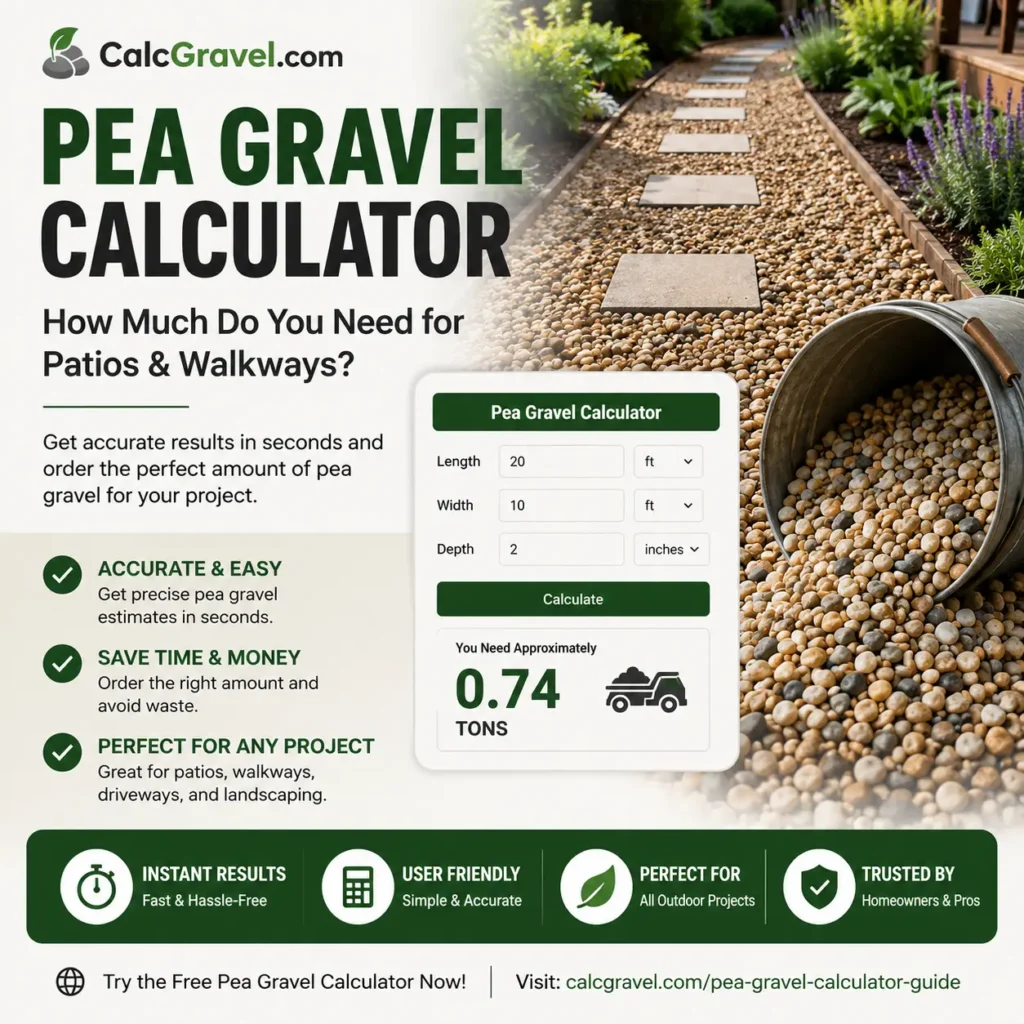
Pea Gravel Calculator
Enter your area, depth and local price. The pea gravel calculator returns cubic yards, tons to order, bags, total cost and a check on whether bulk or bags is cheaper. It works for rectangles, circles and any area you already measured in square feet.
Pea Gravel Calculator: Cubic Yards, Tons, Bags and Cost
Free estimate. Includes waste, delivery, tax and a bag vs bulk price check.
Need a different material? Try the gravel calculator, cubic yard calculator or stone calculator.
How Much Pea Gravel Do I Need?
Multiply the area in square feet by the depth in inches, then divide by 324 to get cubic yards. Multiply cubic yards by 1.35 to get tons. Add about 10 percent for settling and uneven ground.
Pea gravel coverage chart
| Depth | Per cubic yard | Per ton | Per 0.5 cu ft bag |
| 1 inch | ~324 sq ft | ~240 sq ft | ~6.0 sq ft |
| 2 inches | ~162 sq ft | ~120 sq ft | ~3.0 sq ft |
| 3 inches | ~108 sq ft | ~80 sq ft | ~2.0 sq ft |
| 4 inches | ~81 sq ft | ~60 sq ft | ~1.5 sq ft |
| 6 inches | ~54 sq ft | ~40 sq ft | ~1.0 sq ft |
A cubic yard holds 27 cubic feet, which equals 54 bags of 0.5 cubic feet. One ton is about 0.74 cubic yards (20 cubic feet).
Worked examples (3 inch depth, 10 percent extra)
| Project | Area | Depth | Volume | Cubic yards | Tons | 0.5 cu ft bags |
| Walkway, 4 x 20 ft | 80 sq ft | 3 in | 22 cu ft | 0.81 | 1.10 | 44 |
| Patio, 10 x 10 ft | 100 sq ft | 3 in | 28 cu ft | 1.02 | 1.38 | 56 |
| Patio, 12 x 12 ft | 144 sq ft | 3 in | 40 cu ft | 1.47 | 1.98 | 80 |
| Dog run, 10 x 20 ft (4 in) | 200 sq ft | 4 in | 73 cu ft | 2.72 | 3.67 | 147 |
| Playground, 15 x 15 ft (12 in start) | 225 sq ft | 12 in | 248 cu ft | 9.17 | 12.38 | 496 |
Tonnage here uses 1.35 tons per cubic yard. Your supplier’s scale ticket is the final word, because moisture and stone density change the weight.
How to calculate pea gravel by hand
- Measure the area. Rectangle: length x width. Circle: radius x radius x 3.14. For irregular shapes, split the space into rectangles and circles and add them.
- Choose the depth. Use the depth table below or the gravel depth guide. Divide inches by 12 to get feet.
- Find the volume. Length x width x depth in feet gives cubic feet. Example: 30 x 4 x 0.25 = 30 cubic feet. Divide by 27 for cubic yards: 30 ÷ 27 = 1.11.
- Convert to tons. Cubic yards x 1.35. Example: 1.11 x 1.35 = 1.5 tons. Add 10 percent and round up to the next quarter ton.
Mistakes that make people run short (or over-order)
- Ignoring low spots. A 1 inch dip across the whole area adds nearly a third more stone to a 3 inch layer. Rake the soil level first.
- Forgetting settling. Online calculators give the loose volume. Buyers commonly report needing 10 to 20 percent more once the stone settles, so keep the 10 percent extra on flat ground and use 15 to 20 percent on uneven ground.
- Paying a second delivery fee. Running out means another $60 to $250 delivery. It is cheaper to order a quarter ton extra.
- Ordering far too much. Leftover stone is easy to use for edging or a path, but a 2 ton pile is a lot of shoveling. Round up to the next quarter ton, not the next whole ton.
Pea Gravel Size and Color
Most pea gravel sold in the US is 3/8 inch, with 1/4 inch and 1/2 inch grades also common. Smaller grades feel softer underfoot, while larger grades stay in place better on slopes and dog runs. For other gravel sizes, see types of gravel, sizes and best uses.
| Color | Typical source | Best for |
| White and cream | Limestone | Modern, minimalist designs |
| Gray and charcoal | Granite | Contemporary, industrial spaces |
| Black | Basalt | Bold, high-contrast beds |
| Brown, tan and gold | Iron-stained sandstone and river stone | Traditional, warm settings |
| Rainbow (mixed) | Natural mix of river stones | Walkways, patios and play areas |
| Dyed colors | Stone painted or tinted | Short-term accents only |
Does rainbow pea gravel fade? Natural rainbow pea gravel does not, because the color is in the stone. Dyed gravel can fade in two or three seasons of sun and rain, so ask whether the color is natural.
Pea Gravel Weight per Cubic Yard and per Ton
One cubic yard of pea gravel weighs about 2,700 pounds (1.35 tons). Wet gravel and denser stone such as granite weigh more, so suppliers quote anywhere from 2,500 to 2,900 pounds.
| Unit | Weight | Volume |
| 1 cubic foot | ~100 lb | 1 cu ft |
| 1 bag (0.5 cu ft) | ~50 lb (labels often say 45 to 50 lb) | 0.5 cu ft |
| 1 cubic yard | ~2,700 lb (1.35 tons) | 27 cu ft |
| 1 ton (2,000 lb) | 2,000 lb | ~20 cu ft (0.74 cu yd) |
| Typical range per cubic yard | 2,500 to 2,900 lb (1.25 to 1.45 tons) | 27 cu ft |
To convert any gravel amount, use the yards to tons calculator.
Pea Gravel Price per Ton and per Yard
Pea gravel is one of the cheapest landscape stones. Bulk prices below are for plain natural stone in the US, November 2026. For prices on other stone types, see the full gravel cost per ton guide.
Pea gravel cost per ton
Plain pea gravel costs about $30 to $55 per ton at the yard. HomeAdvisor lists $10 to $50, LawnStarter reports $25 to $53 with an average near $39, and online bulk suppliers quote $30 to $55. Colored stone adds roughly $20 to $50 per ton. Reddit buyers report $40 to $85 per ton once delivery is included.
Pea gravel cost per yard
At 1.35 tons per cubic yard, expect about $40 to $75 per cubic yard for the stone alone. A bagged cubic yard (54 bags) costs about $215 to $380 at $4 to $7 per bag, which is why bags only make sense for small jobs.
| How you buy it | Typical price | Notes |
| Per 0.5 cu ft bag | $4 to $7 | ~50 lb; big-box stores such as Home Depot, Lowe’s and Menards |
| Per ton (bulk, material) | $30 to $55 | Wider $25 to $60 range by region and color |
| Per cubic yard (bulk, material) | $40 to $75 | Per-ton price x 1.35 |
| Delivery fee | $60 to $250 | Flat fee; some yards set a 3 to 5 ton minimum |
| Colored or specialty stone | +$20 to $50 per ton | Natural colors cost less than dyed |
How much is a load of pea gravel?
A delivered load is the stone price plus the delivery fee. A 1.5 ton order at $40 per ton plus $100 delivery is about $160. Buyers often get caught by minimums: a few yards charge a flat delivery fee of $150 to $250 even for one ton. If you only need a little, borrowing a pickup and loading at the yard can be cheaper.
Cost by project (material plus a typical $100 delivery)
| Project | Tons (with 10% extra) | Material + delivery |
| Walkway, 4 x 20 ft | 1.10 tons | $133 to $160 |
| Patio, 10 x 10 ft | 1.38 tons | $141 to $176 |
| Patio, 12 x 12 ft | 1.98 tons | $159 to $209 |
| Dog run, 10 x 20 ft (4 in) | 3.67 tons | $210 to $302 |
Labor, edging, a stone base and landscape fabric are extra. DIY installs typically run about $1.00 to $2.50 per square foot all in, and professional installs about $1.50 to $4.50 per square foot (estimates; LawnStarter reports a national range of $0.86 to $3.78 per square foot).
Ways to pay less
- Buy bulk instead of bags for anything over about 50 square feet; bulk is commonly cited as around a third of the bagged price per ton.
- Pick up at the yard if you have a truck, since delivery is often the largest line on the quote.
- Order once and round up to the next quarter ton to avoid a second delivery fee.
- Ask two or three local yards for a delivered price per ton and compare, since quarry distance drives the number.
Best Uses for Pea Gravel
Walkways and garden paths
Pea gravel is comfortable underfoot and drains well. Use 2 to 3 inches over a compacted base and keep it in with edging so the stones stay out of the lawn.
Patios and seating areas
It is a low-cost patio surface that drains quickly. Furniture legs can sink, so set pavers or stepping stones into the gravel under tables. Use 3 to 4 inches over a compacted crushed stone base.
Dog runs
Smooth stones are gentle on paws and drain urine, but pea gravel has trade-offs. Scooping waste picks up stones, and urine can build an odor if the base drains poorly. A permeable base and rinsing the area help. Some owners prefer 3/4 inch angular stone for dog runs.
Playgrounds
Pea gravel is an approved loose-fill surface, but it only protects falls from equipment up to 5 feet high, per the U.S. Consumer Product Safety Commission. See the playground depth rules below.
Drainage and French drains
Washed pea gravel works around perforated pipe in a French drain when wrapped in fabric. Do not mix it with larger drain rock such as #57 stone, because the small stones fill the gaps and block water flow. See our French drain guide.
Decorative mulch
A 1.5 to 2 inch layer suppresses weeds and does not rot. Leave a 6 inch gap around tree trunks.
Pea Gravel Driveway: Pros and Cons
A pea gravel driveway looks great and costs little, but it is not the best base material for vehicles. Because the stones are round, they roll under tires like ball bearings, form ruts and scatter when you plow snow.
| Pros | Cons |
| Low cost per ton | Stones do not lock together and shift under tires |
| Drains water quickly | Ruts form where tires travel |
| Smooth, attractive color range | Snow shoveling or plowing removes gravel |
| Easy to spread and refill | Spreads into lawn and beds without deep edging |
| Quiet and comfortable on foot | Needs a 4 to 6 inch compacted stone base and top-ups every year or two |
Verdict: use crushed stone for the driveway itself and pea gravel only as a thin decorative top layer, or use a stabilizer grid. See how to lay a gravel driveway, the driveway gravel calculator and the crusher run and road base guide.
How Deep Should Pea Gravel Be?
| Project | Recommended depth | Notes |
| Garden borders | 1.5 to 2 inches | Add fabric to block weeds |
| Walkways and paths | 2 to 3 inches | Over a 2 to 4 inch compacted base |
| Decorative landscaping | 2 to 3 inches | |
| Patios and seating | 3 to 4 inches | Compacted crushed stone base |
| Dog runs | 3 to 4 inches | Permeable base for drainage |
| Driveway top layer | 3 to 4 inches over a 4 to 6 inch stone base | Crushed stone is better for the base |
| French drains | 8 to 12 inches total | 2 inch base, pipe, then 6 to 8 inches on top |
| Playgrounds | 9 inches compressed (start with 12) | Protects up to 5 ft fall height |
For playgrounds, the Consumer Product Safety Commission’s Public Playground Safety Handbook calls for at least 9 inches of compressed loose fill, and pea gravel only protects to a 5 foot fall height. Start with 12 inches because it compresses over time, and top it up. See the gravel depth guide for other projects.
Does pea gravel need a base and fabric?
Yes. Without a base the stones sink into soft soil. Compact the soil, add 2 to 4 inches of crushed stone or crusher run, then the pea gravel. Use crusher run, not sand, under loose pea gravel, because round stones shift in sand. Landscape fabric stops the layers mixing but will not block weeds for good, since seeds land in the gravel itself.
Edging and installation tips
- Install firm edging, such as steel, pavers or deep plastic, at least 4 inches into the ground to keep stones out of the lawn.
- Level and compact the soil before you add stone.
- Rake the gravel flat, then check the depth in several spots.
- Rinse dusty bagged gravel if it arrives dirty.
Pea Gravel vs Crushed Stone and Other Materials
Pea gravel is smooth and rounded; crushed stone is angular and locks together. Crushed stone is better for load-bearing uses, while pea gravel wins on comfort and looks. Read the full pea gravel vs crushed stone comparison.
| Material | Stays firm? | Best for | Main drawback |
| Pea gravel | No (loose) | Paths, patios, play areas, dog runs | Shifts under weight |
| Crushed stone | Yes (locks) | Driveways, bases | Sharper edges |
| Decomposed granite | Yes (with stabilizer) | Firm paths | Tracks indoors, can get muddy |
| River rock | No | Slopes, erosion control | Large and uneven to walk on |
| Organic mulch | No | Planting beds | Breaks down, needs refreshing |
| Pavers | Yes | Furnished patios | Higher cost |
Quick decision guide
- Driveway: crushed stone
- Patio with furniture: pavers or stepping stones set in pea gravel
- Path or walkway: pea gravel or stabilized decomposed granite
- Sloped bank: river rock
- Dog run: pea gravel or 3/4 inch angular stone
Pea Gravel FAQ
How much does pea gravel cost per ton?
Pea gravel typically costs $30 to $55 per ton for the stone itself in 2026, with a wider range of $25 to $60 depending on color, region and quantity. Delivery usually adds $60 to $250. Small orders under a ton often cost more per ton because of minimum delivery fees. See our gravel cost per ton guide for other stone types.
How much does a yard of pea gravel weigh?
One cubic yard of pea gravel weighs about 2,700 pounds, or 1.35 tons. Depending on moisture and the quarry, it ranges from about 2,500 to 2,900 pounds (1.25 to 1.45 tons). To convert other amounts, use our yards to tons calculator.
How many square feet does a ton of pea gravel cover?
A ton of pea gravel covers about 120 square feet at 2 inches deep, 80 square feet at 3 inches deep and 60 square feet at 4 inches deep. These figures assume 1.35 tons per cubic yard and no extra for settling, so add about 10 percent when you order.
Is pea gravel good for driveways?
Usually not. Pea gravel is rounded, so the stones do not lock together and shift under tires, which creates ruts and loose patches. Crushed stone such as crusher run or #57 holds a driveway far better. Pea gravel can work as a thin decorative top layer over a compacted stone base with edging.
How deep should pea gravel be?
Use 2 to 3 inches for walkways, 3 to 4 inches for patios and dog runs, and 1.5 to 2 inches for garden borders. Playgrounds need 9 inches of compressed pea gravel, so start with 12 inches. See the full gravel depth guide for more project depths.
How much pea gravel do I need for a 10×10 patio?
A 10 x 10 foot patio at 3 inches deep needs about 25 cubic feet, or 0.93 cubic yards. With 10 percent extra for settling, order about 1 cubic yard, which weighs roughly 1.4 tons. That also equals about 55 bags of 0.5 cubic feet.
How many bags of pea gravel are in a cubic yard?
A cubic yard holds 27 cubic feet, so it takes 54 bags of 0.5 cubic foot pea gravel to equal one cubic yard. Each bag weighs roughly 45 to 50 pounds. Bagged gravel is convenient for small jobs but costs far more per ton than bulk delivery.
How much is a load of pea gravel?
A delivered load costs the stone price plus a delivery fee. Expect $30 to $55 per ton for the gravel and $60 to $250 for delivery, and some yards set a minimum order of 3 to 5 tons. Ask your supplier whether the quote includes delivery and tax.
Does pea gravel need a base or landscape fabric?
Yes, for most projects. A compacted 2 to 4 inch layer of crushed stone under the pea gravel keeps the stones from sinking into the soil. Landscape fabric separates the layers but will not stop weeds forever, because seeds land on top of the gravel and sprout there.
Does rainbow pea gravel fade?
Natural rainbow pea gravel does not fade because the color comes from the stone itself. Dyed or painted gravel can lose color within a few seasons of sun and rain. Ask the supplier whether the colors are natural before you buy.
How We Researched This Guide
Prices were checked in November 2026 against HomeAdvisor, LawnStarter and Hello Gravel’s pricing guide, then combined with buyer reports from Reddit and landscaping forums. Playground depths follow the CPSC handbook. Weight and coverage figures are calculated from 1.35 tons per cubic yard (27 cubic feet per cubic yard).
Prices vary by region, quarry and season, so treat every figure as an estimate and confirm with a local supplier. Use our where to buy gravel near you guide to find yards. Browse all our gravel guides.
Ready for exact numbers? Jump back to the pea gravel calculator above and enter your measurements.