

How to Install a Gravel Driveway (Step-by-Step)
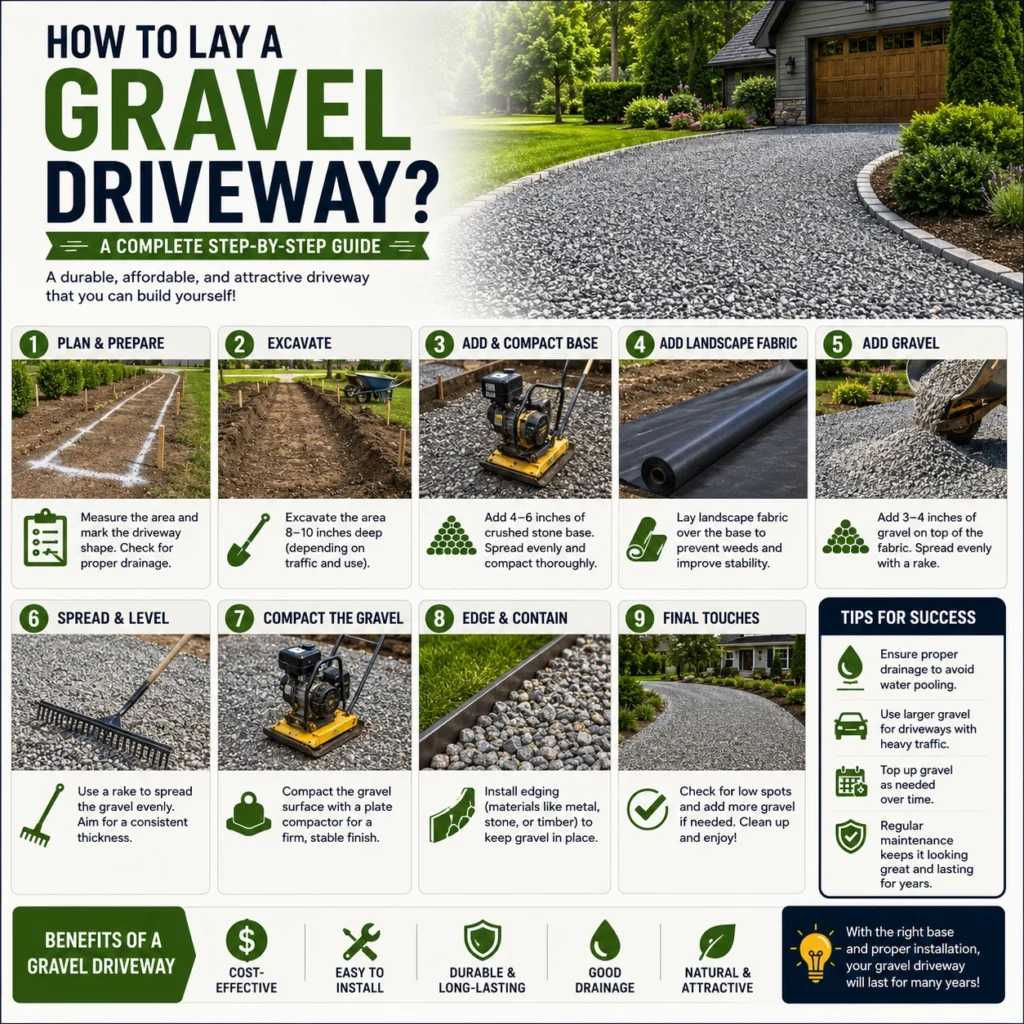
Quick answer: To install a gravel driveway, strip topsoil, dig to 8 to 12 inches, and shape a crown. Lay fabric over soft soil. Compact 6 to 9 inches of crusher run in lifts of 4 inches or less. Finish with 2 to 3 inches of #57 stone. A standard 12 x 50 ft drive needs about 22.8 tons.
Base and surface stone, fabric and compaction lifts for your driveway
Estimate only. Stone weight varies by quarry, usually 1.3 to 1.5 tons per cubic yard, so confirm with your supplier. For delivery fees and more shapes use our driveway gravel calculator.
This guide covers gravel driveway installation from the first stake to the last pass of the compactor. You will get depth tables, tonnage for common sizes and 2026 cost ranges. Want only the quantity? Jump to our driveway gravel calculator.
Gravel driveway installation overview
A good gravel driveway is a layered system, not a pile of stone. Professional gravel driveway installation follows the same layers a DIYer should. Each layer has one job. Most failures trace back to a skipped step in the lower layers, not the stone you see on top.
| Layer | Material | Compacted depth | Job |
|---|---|---|---|
| Surface | #57 or 3/4 in crushed stone | 2-3 in | Traction and a clean look |
| Base | Crusher run, road base or 3/4 in minus | 6-9 in (4-6 in light use) | Carries vehicle weight |
| Separation | Woven geotextile fabric | Single layer, 12 in overlaps | Keeps base out of soft soil |
| Subgrade | Firm subsoil, compacted and shaped | Crowned 1/4-1/2 in per ft | Drains water and supports it all |
Gravel driveway installation steps at a glance:
- Plan, measure, mark and call 811.
- Excavate to depth and shape the crown.
- Roll out geotextile fabric.
- Build the base in compacted lifts.
- Spread and compact the surface stone.
- Set edging and handle drainage.
Why choose gravel at all? It drains water, costs less than paving, and is easy to repair. Our gravel depth guide shows how depth changes by use.
Tools and materials for gravel driveway installation
Rent the heavy tools and order the stone by weight. Here is what a DIY gravel driveway installation needs.
| Item | Why you need it |
|---|---|
| Crusher run, road base or 3/4 in minus | Base layer that compacts hard because of its fines |
| #57 or 3/4 in crushed stone | Surface layer, angular so it locks together |
| Woven geotextile fabric | Separates base from soft or clay subgrade |
| Plate compactor (rental about $60 a day per one supplier guide) | Compacts base and surface in thin lifts |
| Edging: steel, stone, timber or concrete | Holds stone in and keeps clean edges |
| Wheelbarrow, rake, shovels, tamper | Moving and leveling stone, hand-compacting edges |
| String, stakes, spray paint, 4 ft level | Layout, crown and slope checks |
| Mini excavator or skid steer (optional) | Saves days on drives over about 500 sq ft |
Not sure which stone to buy? Read our types of gravel, sizes and weights and the crusher run and road base guide. Pea gravel is a poor driveway choice. See pea gravel vs crushed stone for why.
Step 1: Plan, measure and mark your gravel driveway
Start gravel driveway installation with paper and paint. Good planning prevents the two costly errors: wrong quantity and wrong drainage direction.
Call 811 before gravel driveway installation
Call 811 before you dig. It is free, and most states require notice two to three business days ahead. See 811 guidance for homeowners. Then ask your city or county about a driveway permit, curb-cut rules and hard-surface limits. Rules vary by location.
Measure, mark and size the gravel driveway installation area
- Stake the edges and run string or spray a line. Use curves for a natural look.
- Plan 10 to 12 ft wide for one car and about 20 ft for two cars side by side.
- Add a turnaround or passing spot on long drives.
- Find where water will go. It should leave the drive and flow away from your house.
- Multiply length by width for square feet.
Example: a 12 x 50 ft driveway is 600 sq ft. At 8 inches deep that is about 16.3 cubic yards or 22.8 tons with 10 percent waste. Use the estimator above or our gravel yards to tons calculator to convert.
Step 2: Excavate and grade (crown and slope)
Dig out to your planned total depth, then shape the subgrade. A crowned, firm subgrade is the foundation of any proper gravel driveway construction.
How deep to dig for gravel driveway installation
| Use and soil | Base | Surface | Dig depth (total) |
|---|---|---|---|
| Light use, firm well-drained soil | 4 in | 2 in | 6 in (minimum) |
| Standard car driveway | 6 in | 2 in | 8 in |
| Clay, soft or wet soil, or delivery trucks | 9 in | 3 in | 12 in |
Sources differ slightly. Supplier guides cite 6 to 8 inches for light use and 8 to 12 inches for heavier loads, with Hunker noting 8 to 12 inches as typical. Our gravel depth guide goes deeper on each use.
Remove topsoil first in gravel driveway installation
- Strip sod, roots and soft topsoil. Haul it away or use it elsewhere.
- Dig to firm subsoil. If it is spongy, dig deeper and fill with base stone.
- Compact the exposed subgrade with the plate compactor.
- Keep the subgrade dry. Do not work after heavy rain.
Set the crown and drainage slope
Shape the subgrade like the finished surface. A crown is a high center that sheds water to both sides. Use 1/4 to 1/2 inch of drop per foot from center to edge. On a 12 ft drive that raises the center by about 1.5 to 3 inches.
Also slope the whole drive away from buildings, at least about 1/4 inch per foot. Standing water is the main cause of potholes and soft spots. Check the shape with string and a level before any stone goes in.
Step 3: Lay geotextile fabric
Fabric is the quiet hero of gravel driveway installation. Roll out woven geotextile over the compacted subgrade. Its main job is separation. It keeps the base from sinking into soft or clay soil and mixing with it.
- Overlap seams by 12 inches, and pin the edges.
- Use heavy-duty woven fabric made for driveways, not thin landscape cloth.
- Run it up the edges slightly so edging can hold it.
- Skip it only on firm, well-drained, sandy or gravelly soil.
Fabric is often sold as a weed block, but homeowners report weeds still sprout in the top stone from blown-in seeds and dust. Treat fabric as separation, not weed control.
Step 4: Build the base layers (depth per layer)
The base carries the load in any gravel driveway installation. Use crushed stone with fines, such as crusher run, road base or 3/4-inch minus. The fines pack it solid. Clean stone with no fines stays loose.
| Build type | Base depth | Lifts of 4 in or less | Surface depth | Total |
|---|---|---|---|---|
| Light use | 4 in | 1 | 2 in | 6 in |
| Standard | 6 in | 2 | 2 in | 8 in |
| Heavy or clay | 9 in | 3 | 3 in | 12 in |
Compact gravel driveway installation base in thin lifts
- Spread stone in lifts no thicker than 4 inches loose. Use 2 to 3 inches with a small rented plate.
- Lightly dampen each lift. It should be damp, not muddy.
- Make overlapping passes with the plate compactor until the surface stops moving.
- Rake the crown back into shape after each lift.
- Repeat until you reach the base depth.
Weak spots show as ruts or pumping under the plate. Dig them out and fill with base stone. For soft subgrades, some contractors add a first layer of larger crushed stone before the road base. Ask your supplier what is common locally and see our crusher run and road base guide.
Step 5: Add the top layer and compact
The surface is the last layer of gravel driveway installation. Use angular #57 stone (about 1/2 to 1 inch) or a 3/4-inch crushed stone for it. Angular edges lock together. Round stone rolls under tires.
- Spread 2 to 3 inches over the finished base. Thicker is not better. Deep loose stone shifts and ruts.
- Rake to the crown. Keep the center higher than the edges.
- Lightly water and make one or two passes with the plate compactor or a roller.
- Check drainage with a hose or after a rain. Fix puddles right away.
Choosing stone for gravel driveway installation
| Stone | Typical use | Notes |
|---|---|---|
| #57 crushed stone (about 1/2-1 in) | Most residential gravel driveways | Angular, drains well, resists tire pickup |
| 3/4 in crushed stone with fines | Surface and base | Binds tightly, can hold more moisture |
| #89 pea-size crushed stone | Decorative surface over a solid base | Needs a firm base or it migrates |
| River or mixed rock | Rustic and long driveways | Compacts decently, looks natural |
Do you need gravel grids?
Grids are plastic cells that you lay on the base and fill with clean stone. They hold stone in place on turns, light slopes and soft ground. They add cost and labor, and they do not replace a good base. Homeowners report washouts on steep or poorly drained drives even with grids.
Step 6: Install edging and manage drainage
Edging stops stone from creeping into lawn and beds. Drainage keeps water from undercutting the base. Both protect your gravel driveway installation for years.
If you build in order, set edging after the base is compacted and before the surface stone goes down. That gives a clean edge to rake against.
| Edging | Strengths | Watch for |
|---|---|---|
| Steel or aluminum | Durable, slim, easy to install | Needs stakes set firmly |
| Stone or pavers | Good looks, permanent | Higher cost and labor |
| Concrete curb | Cleanest edge, very permanent | Costly, hard to change |
| Pressure-treated timber | Budget friendly | Rots over time |
Drainage fixes for gravel driveway installation
- Keep the crown and the slope away from the house.
- Add a swale, ditch or culvert where water crosses the drive.
- Use a French drain or trough drain at the low end if water pools.
- Place a short paved or large-stone apron where the drive meets the road.
Drainage is the most common complaint in homeowner discussions of DIY gravel driveways. Read our French drain guide if your site is flat or sits below the road.
Gravel driveway installation cost
Most professionals quote about $1 to $3 per square foot for basic gravel driveway installation. Jobs with heavy excavation, hauling or regrading can reach $4 to $8 per square foot. DIY material costs less, but you pay for rental and your time.
| Driveway size | Sq ft | DIY gravel materials ($0.40-$2.00/sq ft) | Pro, basic job ($1-$3/sq ft) | Pro, heavy prep ($4-$8/sq ft) |
|---|---|---|---|---|
| Single-car apron, 10 x 20 ft | 200 | $80 – $400 | $200 – $600 | $800 – $1,600 |
| Two-car pad, 20 x 24 ft | 480 | $192 – $960 | $480 – $1,440 | $1,920 – $3,840 |
| Typical drive, 12 x 50 ft | 600 | $240 – $1,200 | $600 – $1,800 | $2,400 – $4,800 |
| Long drive, 12 x 100 ft | 1,200 | $480 – $2,400 | $1,200 – $3,600 | $4,800 – $9,600 |
Ranges come from LawnStarter, Inch Calculator and Hello Gravel. Local labor, haul distance and stone type move the numbers. Treat them as planning ranges and get two or three written quotes.
Hidden costs of gravel driveway installation
- Land clearing: roughly $1.18 to $2.00 per sq ft.
- Concrete removal: about $2 to $6 per sq ft.
- Labor: often $20 to $70 per hour per worker.
- Edging, culverts and French drains add to the base price.
- Delivery fees depend on distance and truck size.
Stone is priced by the ton or cubic yard. Check current prices in our gravel cost per ton guide and find suppliers on our where to buy gravel near me page. Both help you price a DIY gravel driveway installation.
DIY or professional gravel driveway installation?
DIY gravel driveway installation works well on flat, small sites if you can rent a plate compactor and move stone by hand. Hire a pro for heavy clay, steep ground, poor drainage, long drives or when you need a mini excavator. A crew of two or three usually finishes a standard driveway in one to three days.
How much gravel do I need for a driveway?
For a 12 x 50 ft driveway at 8 inches, plan on about 22.8 tons including 10 percent waste. The table shows common sizes using 1.4 tons per cubic yard. Use the estimator above for your exact numbers.
| Driveway | Sq ft | Light use (6 in total) | Standard (8 in total) | Heavy or clay (12 in total) |
|---|---|---|---|---|
| Single-car apron, 10 x 20 ft | 200 | 5.7 tons (4.1 cu yd) | 7.6 tons (5.4 cu yd) | 11.4 tons (8.1 cu yd) |
| Two-car pad, 20 x 24 ft | 480 | 13.7 tons (9.8 cu yd) | 18.3 tons (13.0 cu yd) | 27.4 tons (19.6 cu yd) |
| Typical drive, 12 x 50 ft | 600 | 17.1 tons (12.2 cu yd) | 22.8 tons (16.3 cu yd) | 34.2 tons (24.4 cu yd) |
| Long drive, 12 x 100 ft | 1,200 | 34.2 tons (24.4 cu yd) | 45.6 tons (32.6 cu yd) | 68.4 tons (48.9 cu yd) |
Order 10 to 15 percent extra for compaction and uneven ground. Soft soil needs the higher end. Convert between units with the cubic yard calculator or get the full delivered-cost picture in the driveway gravel calculator. Need to start from the home page tool? Try the gravel calculator.
Common gravel driveway installation mistakes
| Mistake | What happens | Fix |
|---|---|---|
| Skipping topsoil removal | Stone sinks and turns muddy | Dig to firm subsoil |
| Thin or no base | Ruts and potholes in one season | Build 6-9 in of compacted base |
| Compacting thick layers | Hidden soft spots settle later | Lifts of 4 in or less |
| No crown or slope | Water pools and washes out stone | 1/4-1/2 in per ft crown |
| Round or clean stone | Rolls and never locks | Angular stone with fines in the base |
| Surface stone too deep | Loose, shifts under tires | Keep to 2-3 in |
| Ignoring the road edge | Stone tracks into the street | Add an apron and edging |
What DIYers report about gravel driveway installation
- Water is the top complaint. Many say they wish they had planned drainage first.
- Weeds still grow from blown-in seeds, so budget for a yearly spray or pull.
- Wetting the stone before compacting gives a tighter result.
- Snow plows can scrape stone away. Raise the blade slightly.
- Some towns count gravel as a hard surface. Check before you build.
These are homeowner reports from video comment threads, not tested rules, so verify against your local conditions.
How to maintain a gravel driveway after installation
| Task | How often |
|---|---|
| Rake stone back into the crown | After storms and as needed |
| Top up with fresh stone | Every 1-2 years |
| Pull or spray weeds | As needed, usually spring |
| Re-compact traffic areas | Annually if rutting |
| Check edging and drainage | Every year before winter |
Gravel driveway installation FAQ
How thick should a gravel driveway be?
A gravel driveway should be 8 to 12 inches thick in total once compacted. That is a 6 to 9 inch crushed-stone base plus a 2 to 3 inch surface layer. Light-use drives can drop to about 6 inches on firm, well-drained soil. Soft clay or heavy trucks need the full 12 inches.
What gravel is best for a driveway base?
Use crushed stone with fines for the base, sold as crusher run, road base or 3/4-inch minus. The fines let it lock tight under a plate compactor. For the top, use angular #57 stone (about 1/2 to 1 inch). See our crusher run and road base guide for the differences.
Do I need fabric under a gravel driveway?
Fabric is strongly advised over soft, clay or wet soil. It separates the base from the subgrade so stone is not pushed into mud. On firm, well-drained ground you can skip it. Fabric does not stop weeds that sprout from seeds blown onto the surface, so plan on occasional weed control either way.
How much does gravel driveway installation cost?
Most installers quote about $1 to $3 per square foot for a basic job. Sites that need heavy excavation, hauling or regrading can run $4 to $8 per square foot. A 12 x 50 ft drive is roughly $600 to $1,800 for a basic job. Doing it yourself costs material and rental only.
How long does a gravel driveway last?
A well-built gravel driveway with a compacted base and good drainage often lasts 10 to 15 years before major rebuilding, and longer with regular raking and top-ups, according to T&M Driveways. Skipping the base or drainage can cut that to under 10 years.
How deep do you dig for gravel driveway installation?
Dig down to your planned total depth, usually 8 to 12 inches below the finished surface. Light residential drives can be as shallow as 6 to 8 inches. Dig deeper over clay or where trucks will drive. Always remove topsoil and roots first so the base sits on firm subsoil.
Do I have to remove grass and topsoil before gravel driveway installation?
Yes. Sod and topsoil hold water, shrink and swell, and rot. Gravel laid over them sinks and turns muddy. Strip grass, roots and soft topsoil down to firm subsoil before you set the crown and compact the subgrade. This is the step first-time DIYers skip most often.
Can I do gravel driveway installation myself?
Yes, if you can rent a plate compactor and move a lot of stone. A single-car drive is typically a weekend job. The hard parts are digging, getting the crown right, and compacting in thin lifts. Hire a pro for steep sites, poor drainage or very long drives.
Do I need gravel grids for a driveway?
No. Grids are optional. They help hold stone in place on lighter slopes, in turning areas and on drives that rut. They do not replace a compacted base. Homeowners report that grids on steep or poorly built drives still wash out, so fix the base and drainage first.
Can I install a gravel driveway on a slope?
Yes on gentle grades, but water and stone move downhill. Keep the crown, add cross drains or a ditch, and use a well-graded base that binds. Contractors commonly warn that very steep grades, roughly above 10 to 12 percent, are better paved or stabilized with grids and drainage.
Can I put gravel over an existing concrete or asphalt driveway?
It is usually not recommended. Loose stone slides on a smooth surface and traps water. If the old surface is sound you can use a grid system with drainage. Otherwise break it out, compact a fresh base and rebuild. Removal adds cost, often $2 to $6 per square foot for concrete.
How do I keep gravel from spreading onto the road or lawn?
Use solid edging along the sides and keep the surface stone no deeper than 3 inches. At the road, a short paved or large-stone apron stops tracking. Rake displaced stone back after storms. Homeowners also report that raising a plow blade a little saves the surface in winter.
Do I need a permit or to call 811 before installing a gravel driveway?
Call 811 before you dig. It is free, and most states require notice 2 to 3 business days ahead. Check your city or county about a driveway or curb-cut permit and any limits on hard surface area. Rules vary, so confirm locally. See 811 for homeowners.
How long does gravel driveway installation take?
A single-car gravel driveway installation is usually a weekend job for a DIYer. A pro crew of two or three often finishes a standard drive in one to three days. Drying time is not needed, but avoid working in heavy rain. Long drives, clay soil and hand digging add days.
Can I use pea gravel for a driveway?
Pea gravel is not recommended for a driveway. Its round stones roll under tires and will not lock together. Use angular crushed stone instead. Pea gravel suits walkways and play areas. Compare both in our pea gravel vs crushed stone guide.
Sources and how we built this gravel driveway installation guide
We compared US and UK installation guides, 2026 cost guides and homeowner and contractor comments on gravel driveway builds. Depths and costs are ranges, and conflicting figures are shown as ranges. This guide is general information, not engineering advice. Confirm with local codes and your supplier. Key references: 811, LawnStarter, Inch Calculator, Hello Gravel, Hunker. Prices checked November 2026.
Related gravel guides and tools
- Driveway gravel calculator
- Gravel depth guide
- Gravel cost per ton in 2026
- Crusher run and road base guide
- Types of gravel, sizes and weights
- Pea gravel vs crushed stone
- French drain guide
- Gravel yards to tons calculator
- Where to buy gravel near me
- All gravel guides
A solid gravel driveway installation comes down to depth, drainage and compaction. Get those right and the surface stays flat for years. Start with the estimator above, then browse all gravel guides.