
Types of Gravel: Sizes, Weights and Best Uses:
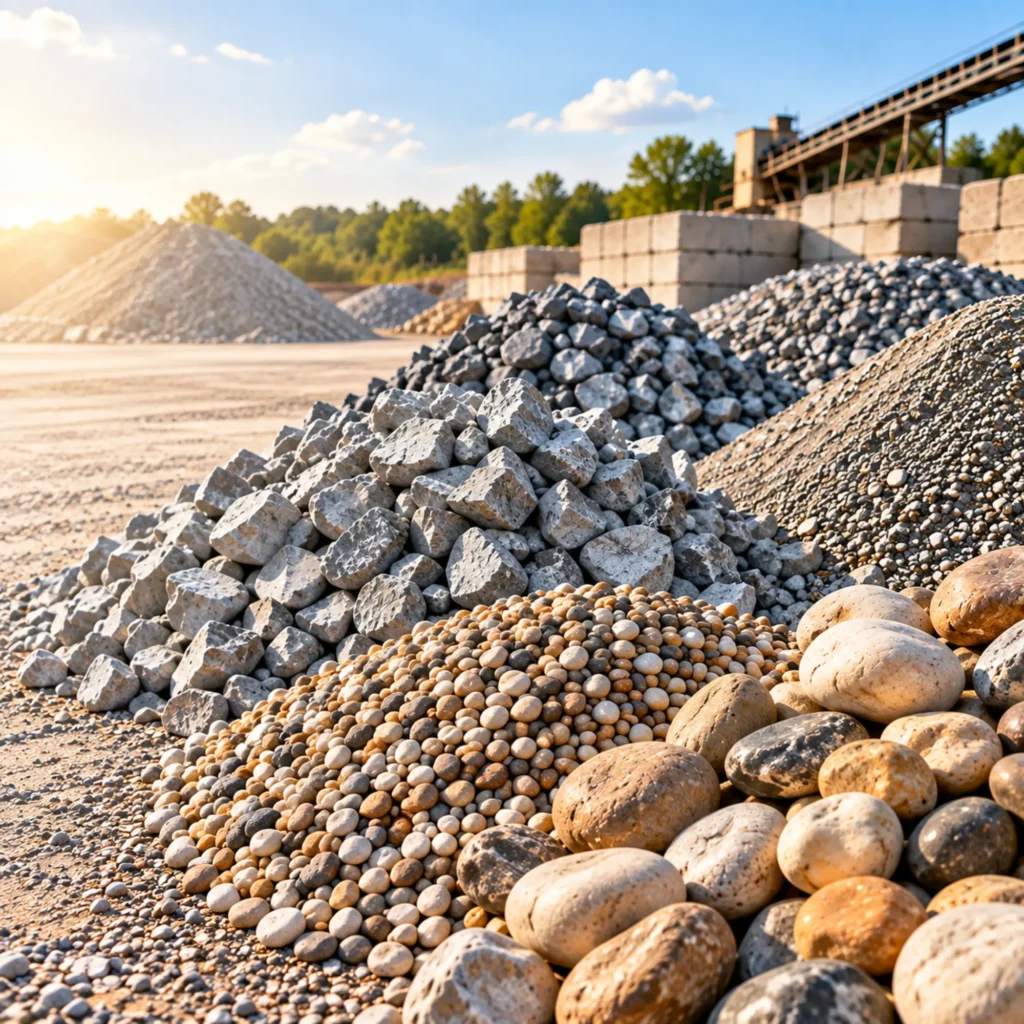
Walk into a stone yard and the names come fast. #57, #411, crusher run, pea gravel, river rock. It is easy to order the wrong one.
This guide keeps it simple. You will see each type, its size, what it weighs and where it works best. Then use the chart to match gravel to your project.
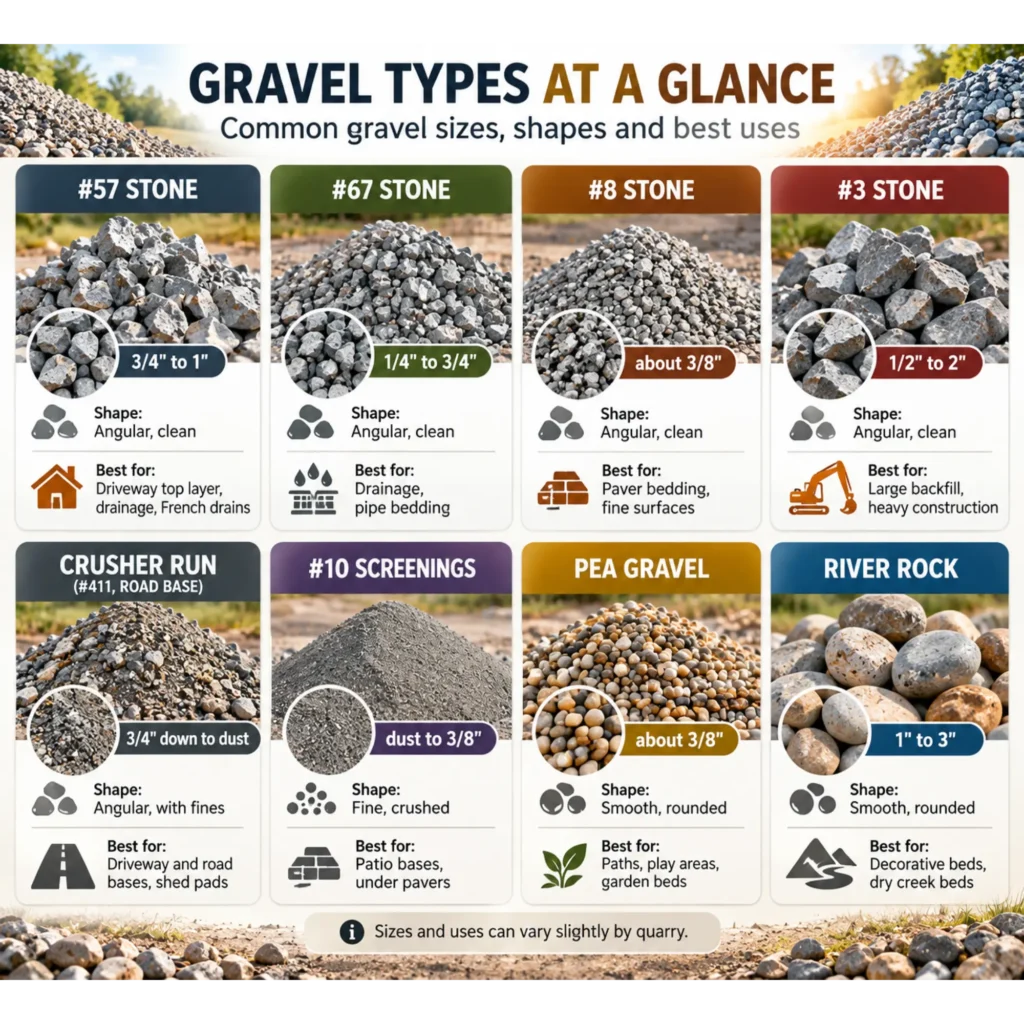
Gravel Types at a Glance
| Type | Typical size | Shape | Best for |
|---|---|---|---|
| #57 stone | 3/4″ to 1″ | Angular, clean | Driveway top layer, drainage, French drains |
| #67 stone | 1/4″ to 3/4″ | Angular, clean | Drainage, pipe bedding |
| #8 stone | about 3/8″ | Angular, clean | Paver bedding, fine surfaces |
| #3 stone | 1/2″ to 2″ | Angular, clean | Large backfill, heavy construction |
| Crusher run (#411, road base) | 3/4″ down to dust | Angular, with fines | Driveway and road bases, shed pads |
| #10 screenings | dust to 3/8″ | Fine, crushed | Patio bases, under pavers |
| Pea gravel | about 3/8″ | Smooth, rounded | Paths, play areas, garden beds |
| River rock | 1″ to 3″ | Smooth, rounded | Decorative beds, dry creek beds |
Sources: HelloGravel size chart and CalculateGravel types guide. Exact size ranges vary a little by quarry.
What Do the Gravel Numbers Mean?
The numbers come from a size classification. In the US, it is ASTM D448, titled “Standard Classification for Sizes of Aggregate for Road and Bridge Construction” (ASTM).
A lower number means bigger stone. So #3 is large and #10 is nearly dust. Names like “crusher run” are not numbers. They are trade names for a mix.
Many yards also sell by local names. Crusher run may be called road base, quarry process or dense-grade aggregate. Ask for the size or the use, and the yard will point you to the right pile.
How Much Does Each Gravel Type Weigh?
Weight matters because yards sell by the ton, but you measure in cubic yards. Heavier stone means fewer yards per ton.
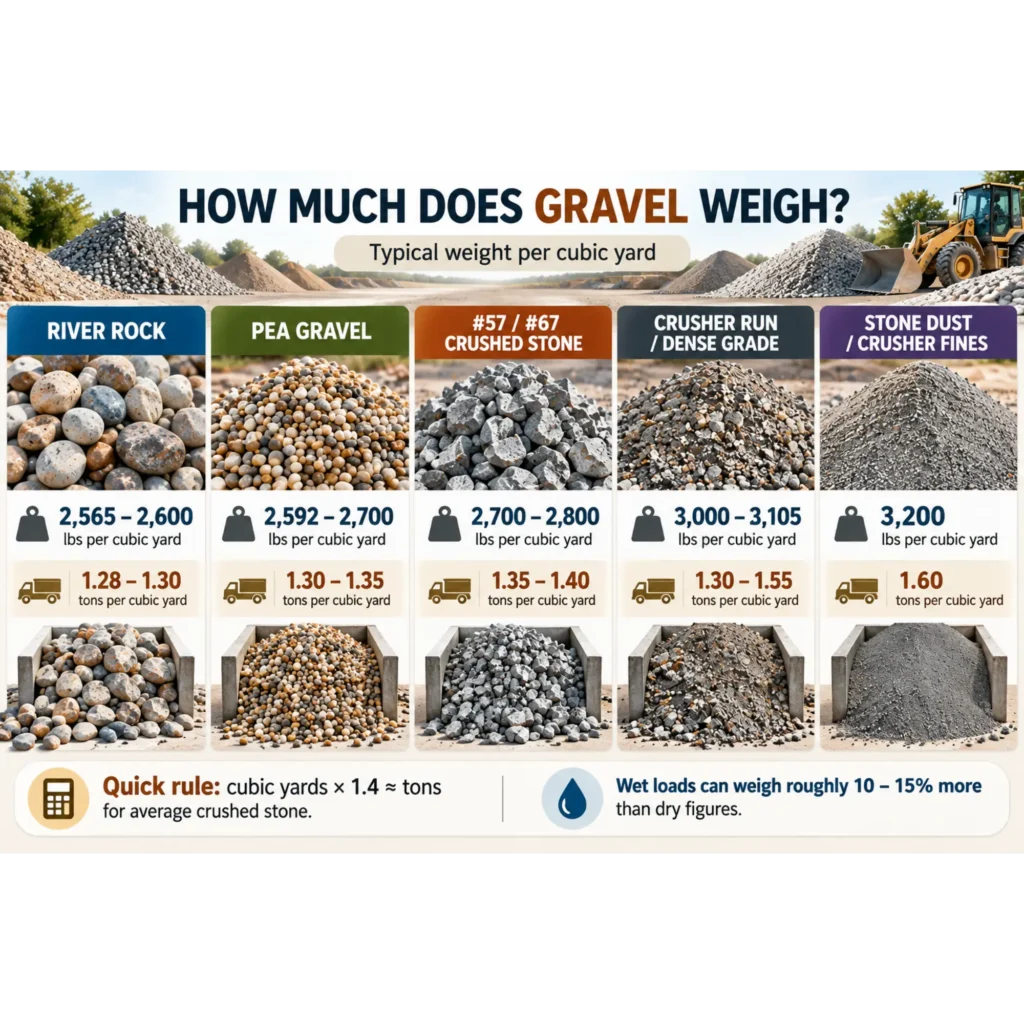
| Material | Lbs per cubic yard | Tons per cubic yard |
|---|---|---|
| River rock | 2,565 to 2,600 | 1.28 to 1.30 |
| Pea gravel | 2,592 to 2,700 | 1.30 to 1.35 |
| #57 / #67 crushed stone | 2,700 to 2,800 | 1.35 to 1.40 |
| Crusher run / dense grade | 3,000 to 3,105 | 1.50 to 1.55 |
| Stone dust / crusher fines | 3,200 | 1.60 |
Ranges combine two published guides: SiteworkMath and GravelCalculate. These are dry, loose figures.
A quick rule: cubic yards x 1.4 gives tons for average crushed stone. Wet loads add roughly 10 to 15 percent. Rain, snow or dust-control hosing can all do it. For an exact conversion, use our yards to tons calculator.
Which Gravel Should You Use?
Driveways
Use two layers. Put crusher run down first, because its fines pack tight and stop the stone from shifting. Top it with #57 for a clean surface that drains.
Angular stone beats round stone here. Round pea gravel rolls under tires. For the full build, see our gravel driveway guide.
Drainage and French Drains
Pick clean stone with no fines. #57 is the common choice around perforated pipe, and #67 works for pipe bedding. The gaps between stones let water through. Fines would clog them.
Our French drain guide shows how to lay it out.
Patios, Walkways and Paver Bases
Use a crusher run or #10 screenings base, then a thin bedding layer such as #8 under pavers. For a soft path or play area, pea gravel feels better underfoot. Check our pea gravel guide for coverage.
Decorative Beds
River rock and pea gravel look best. They are smooth and come in natural colors. They do not lock together, so keep them out of high-traffic areas.
Crusher Run vs #57: The Short Version
Crusher run holds fines, so it compacts into a firm, dense layer. #57 has almost no fines, so water passes through fast. HelloGravel notes that a hybrid works well: a crusher run base with #57 on top (source).
Want more detail on crusher run? Read our crusher run and road base guide. Comparing round and angular stone? See pea gravel vs crushed stone.
What Does Each Type Cost?
Prices change by region and delivery distance. As one benchmark, HomeGuide lists pea gravel at $45 to $80 per cubic yard, or $30 to $55 per ton, for material only. A ton of pea gravel covers about 120 to 130 square feet at 2 inches deep.
For a full price breakdown by material and delivery, see our gravel cost per ton guide. To find a local yard, try where to buy gravel near me.
How Much Gravel Do You Need?
Measure length, width and depth. Multiply to get cubic feet, then divide by 27 for cubic yards. Then pick your type and convert to tons using the weights above.
Or skip the math. Enter your numbers in our gravel calculator. If you are unsure about depth, our gravel depth guide lists it by project. Order about 10 percent extra for settling.
Frequently Asked Questions:
What is the best gravel for a driveway?
Crusher run for the base and #57 for the top layer. Crusher run locks together when compacted. #57 drains well and looks clean.
What does #57 gravel mean?
It is a size number from the ASTM D448 classification. #57 is angular clean stone, roughly 3/4 inch to 1 inch, with almost no fines.
How much does a cubic yard of gravel weigh?
Most gravel weighs about 2,600 to 3,200 lbs per cubic yard, or 1.3 to 1.6 tons. Pea gravel and river rock sit at the lighter end. Crusher run and stone dust sit at the heavier end.
Is pea gravel or crushed stone better?
It depends on the job. Crushed stone is better for driveways and bases because its edges lock together. Pea gravel is better for paths, play areas and decorative beds.
Does wet gravel weigh more?
Yes. Wet loads can weigh 10 to 15 percent more than the dry figures. That is the most common reason a supplier ticket differs from your calculation.
What gravel should I use around a French drain pipe?
Use clean, washed stone such as #57. Its large gaps let water move through easily.