
Gravel Yards to Tons Calculator — Convert Cubic Yards to Tons Instantly
Last Updated 14 sep at 9:00 PM
Cubic yards measure space. Tons measure weight. Your gravel project uses one — your supplier bills you in the other.
Get the yards to tons conversion wrong, and you’ll either overpay for extra material or run short halfway through the job.
This guide gives you the exact yards to tons formula, gravel-specific density numbers, and ready-to-use conversion charts. Convert your numbers in seconds, and order exactly what you need. That’s exactly what our Gravel Yards to Tons Calculator solves.
Quick Answer: How Many Tons in a Yard of Gravel?
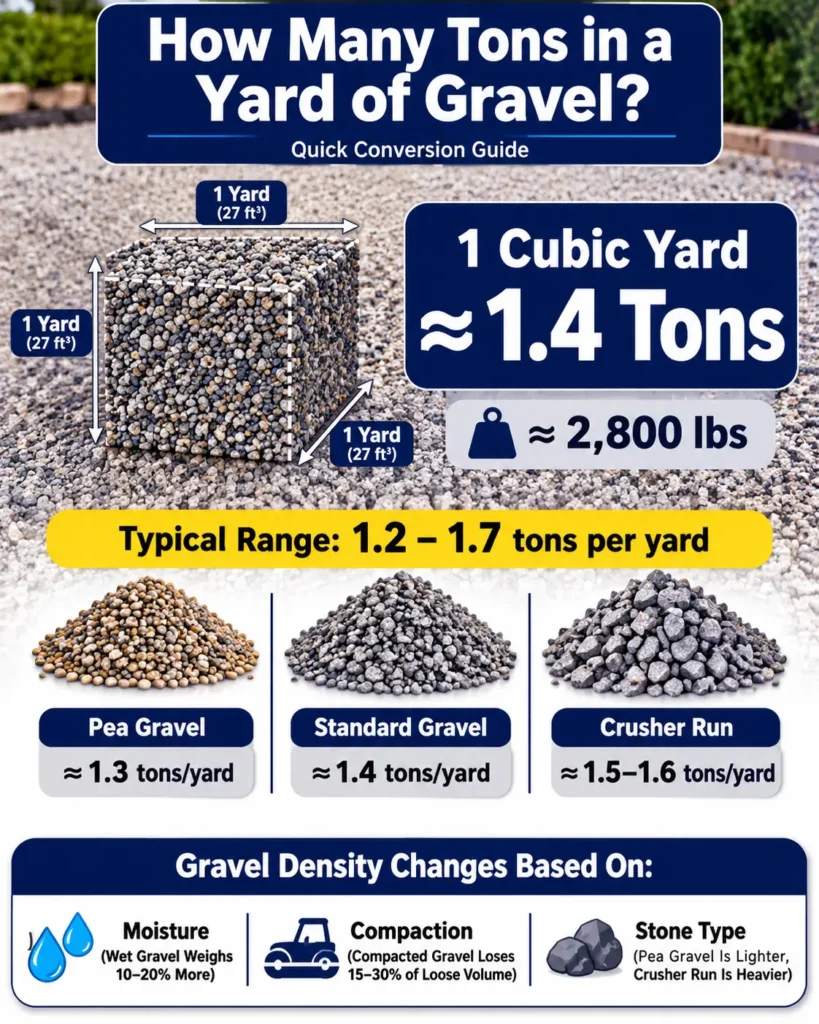
One cubic yard of gravel weighs about 1.4 tons. That’s roughly 2,800 lbs.
This yards to tons figure is a solid rule of thumb. But the real number can shift between 1.2 and 1.7 tons, depending on stone type, moisture, and how tightly it’s packed. Run your own numbers through the Gravel Yards to Tons Calculator above for an exact figure.
Pea gravel runs lighter, closer to 1.3 tons per yard. Crusher run runs heavier, often past 1.5 tons. If you’re comparing gravel against other materials, check our gravel cost per ton guide for current pricing by type.
Gravel Yards to Tons Calculator: How to Use It:
Enter your volume in the calculator above for an instant yards to tons conversion. Or enter a known weight to see how many cubic yards it fills.
Not sure of your project’s volume yet? Start with our full gravel calculator or the cubic yard calculator. Then bring that number back here to convert it to tons.
The Gravel Yards to Tons Formula
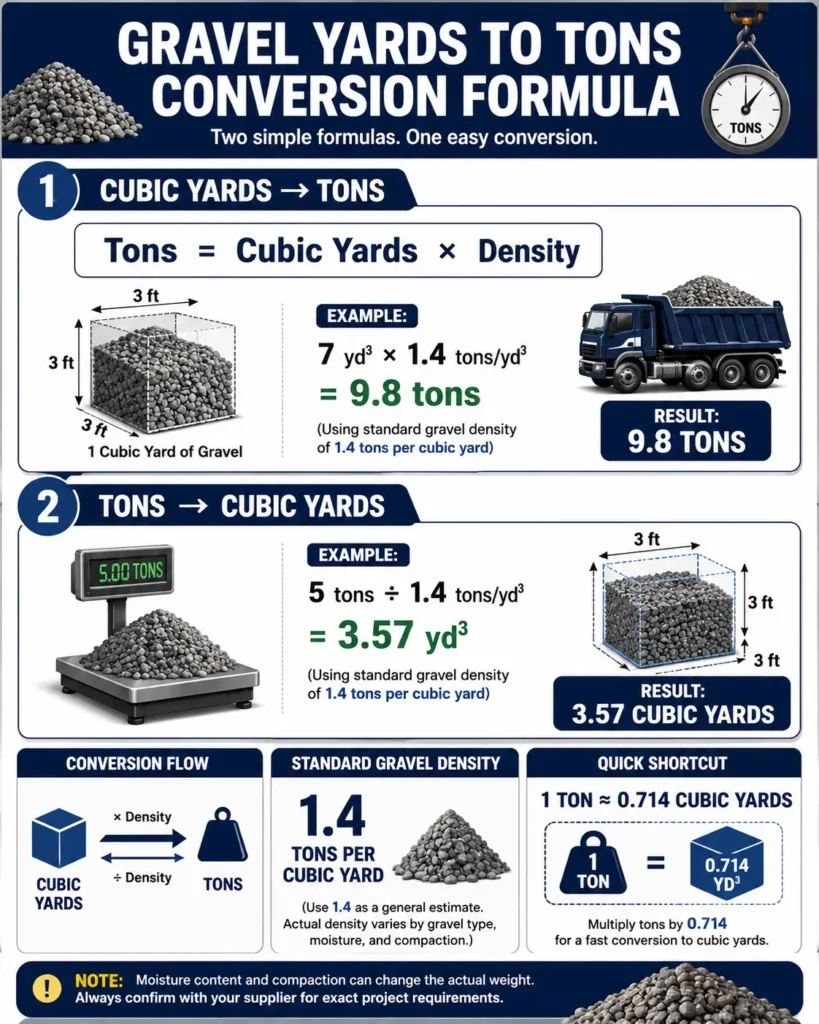
Every yards to tons conversion comes down to one thing: density. Once you know a material’s density, the math takes seconds.
Tons = Cubic Yards × Density
To convert cubic yards to tons, multiply your volume by the density factor. The formula is simple: Tons = Cubic Yards × Density.
For standard gravel, use 1.4 as your multiplier. Seven cubic yards works out to 7 × 1.4 = 9.8 tons.
How to Convert Tons to Cubic Yards of Gravel
Sometimes you need the reverse. Say you know a truck’s weight limit and want the volume it holds.
Use this formula: Cubic Yards = Tons ÷ Density. For standard gravel, divide by 1.4. Or multiply by 0.714 for a quick shortcut. Five tons of gravel fills about 3.57 cubic yards.
Two factors can throw this off. Wet gravel weighs 10–20% more than dry gravel of the same volume. And compacted gravel loses 15–30% of its loose volume once it’s spread and pressed down. Both matter before you place an order. Our gravel driveway installation guide covers compaction allowances in detail.
Cubic Yards to Tons Conversion Chart
This chart uses the standard 1.4 tons-per-yard multiplier. Use it for a fast yards to tons estimate on common order sizes.
| Volume (Cubic Yards) | Estimated Weight (Tons) |
|---|---|
| 1 yard | 1.4 tons |
| 3 yards | 4.2 tons |
| 5 yards | 7.0 tons |
| 7 yards | 9.8 tons |
| 10 yards | 14.0 tons |
| 15 yards | 21.0 tons |
| 20 yards | 28.0 tons |
| 50 yards | 70.0 tons |
Gravel Yards to Tons Calculator: 1 Yard Example:
One loose cubic yard of standard gravel weighs roughly 1.4 tons. Pea gravel runs lighter, near 1.3 tons. Crusher run runs heavier, near 1.55 tons. Actual weight typically falls between 1.2 and 1.6 tons.
5 Tons of Gravel in Yards
Five tons of gravel converts to about 3.57 cubic yards. That’s 5 × 0.714. Depending on the stone, this can range from 3.3 to 4.1 cubic yards.
10 Yards of Gravel in Tons
Ten cubic yards of loose gravel weighs about 14 tons at standard density. Lighter river rock might land near 12.8 tons. Dense crushed stone can reach 17 tons for the same volume.
20 Tons of Gravel in Yards
Twenty tons of gravel fills roughly 14.28 cubic yards. That’s close to a full tandem-axle dump truck load, which usually carries 15–20 tons per trip.
Worked Examples
See how the Gravel Yards to Tons Calculator handles three common project scenarios. Real numbers make the formula easier to trust. Here are three common scenarios.
Example 1 — Converting Yards to Tons
A landscaping bed needs 7 cubic yards of standard gravel. At 1.4 tons/yd³: 7 × 1.4 = 9.8 tons.
Example 2 — Converting Tons to Yards
You’re ordering 5 tons of gravel. How much space will it fill? 5 ÷ 1.4 ≈ 3.57 cubic yards.
Example 3 — Calculating Gravel for a Driveway
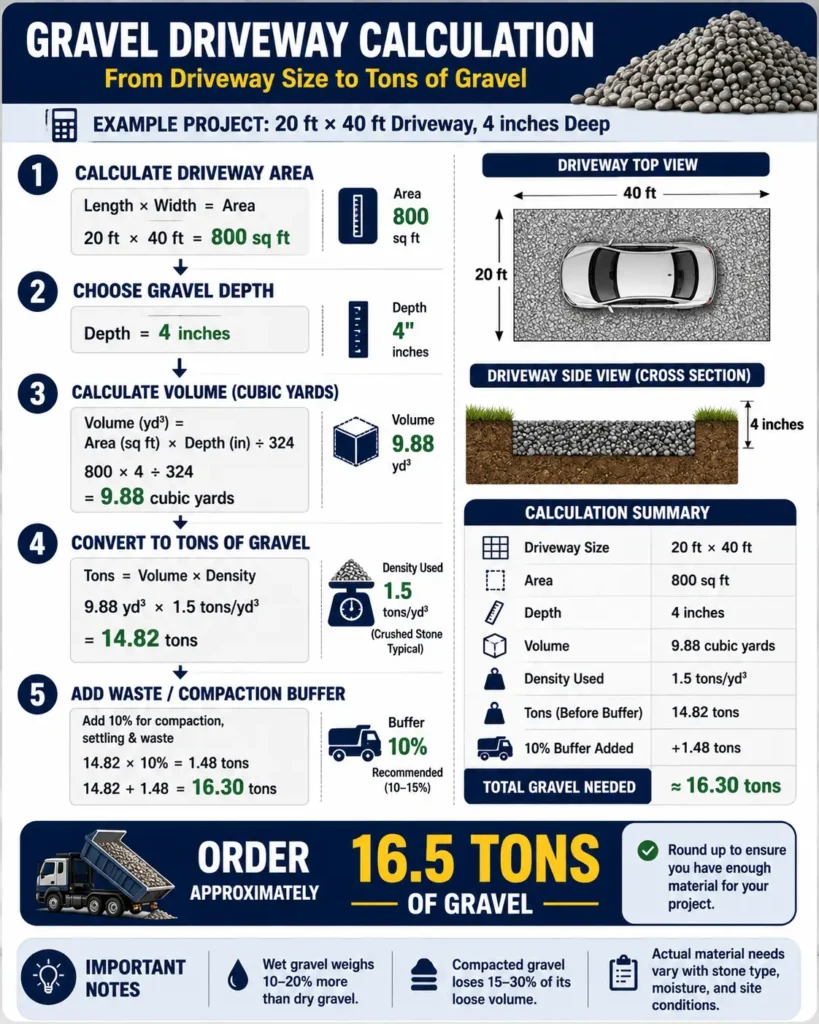
A 20 ft × 40 ft driveway needs 4 inches of gravel. Area comes to 800 sq ft. At 4 inches deep, that’s about 9.88 cubic yards.
Using crushed stone at 1.5 tons/yd³: 9.88 × 1.5 = 14.82 tons. Add a 10% waste buffer, and the total lands near 16.3 tons. Round up to 16.5 tons for delivery. For depth guidance by project type, see our gravel depth guide.
Tons per Cubic Yard by Gravel Type:
Not all gravel weighs the same. Shape, size, and mineral content all change the density — and the yards to tons math with it.
Pea Gravel Tons per Yard
Pea gravel typically weighs 1.25–1.5 tons per cubic yard. Most contractors plan around 1.3–1.4 tons. Its round shape leaves more air gaps, so it compacts less firmly than angular stone. Compare it in our pea gravel vs crushed stone guide, or get a project estimate with the pea gravel calculator guide.
Crushed Stone Tons per Yard:
Crushed stone runs heavier — usually 1.35–1.7 tons per yard. Standard #57 stone is often estimated at 1.4 tons/yd³. But mineral type matters: granite-based stone weighs less than limestone. Denser blends with stone dust, like #411, average closer to 1.5 tons per yard.
River Rock, Decomposed Granite & Crusher Run
River rock generally falls between 1.1 and 1.4 tons per yard. Decomposed granite runs 1.3–1.5 tons, often planned at 1.45 tons/yd³. Crusher run is the heaviest of the three, built for compaction at 1.4–1.6 tons per yard.
Why Density Changes the Conversion
Density decides the actual weight behind any yards to tons calculation. And it’s rarely fixed.
Dry vs Wet Gravel Weight
Wet gravel weighs 10–20% more than dry gravel at the same volume. Water fills the gaps between stones. Since suppliers bill by weight, ordering after rain can mean less actual stone per ton than dry-density charts suggest.
Compacted vs Loose Gravel
Gravel moves through three states: bank, loose, and compacted. Once spread and pressed for a driveway or base, air gaps close and volume shrinks by 15–30%. To reach 10 cubic yards of finished, compacted depth, order 12.5–13.3 cubic yards of loose material.
Metric Conversion: Cubic Meters to Tonnes
Metric projects use the same logic. Tonnes = Cubic Meters × Density (t/m³).
Standard #57 gravel runs about 1.6 t/m³. Pea gravel sits near 1.5 t/m³. Crusher run runs closer to 1.9 t/m³. A 5 m³ order of standard stone at 1.6 t/m³ works out to 8 metric tonnes.
One note: a metric tonne (1,000 kg) is about 10% heavier than a US short ton (2,000 lbs). Don’t mix the two when ordering internationally.
Frequently Asked Questions
How many yards are in a ton of gravel?
About 0.714 cubic yards, based on the standard 1.4 tons-per-yard density. This ranges from 0.59 to 0.91 cubic yards depending on stone type.
How many tons are in a cubic yard of gravel?
Around 1.4 tons on average. Most falls between 1.3 and 1.5 tons, depending on material and moisture. Use the Gravel Yards to Tons Calculator above for an instant, project-specific number
How many yards is 5 tons of gravel?
About 3.57 cubic yards. That’s 5 × 0.714.
Is a ton the same as a tonne?
No. A US ton is 2,000 lbs. A metric tonne is 1,000 kg, or about 2,204.6 lbs — roughly 10% heavier.
How many cubic feet are in a ton of gravel?
About 18–22 cubic feet. At a common 100 lb/ft³ density, one ton equals exactly 20 cubic feet.
How many tons of gravel do I need for a driveway?
A single-car driveway (12′ × 40′ at 4″ deep) needs about 10 tons. A two-car driveway (20′ × 40′ at 4″ deep) needs about 16.6 tons. Add a 10–15% buffer for compaction and settling. See our driveway installation guide for the full process.
Why does my supplier quote in tons but I calculated in yards?
Truck scales measure weight directly and consistently. Volume, on the other hand, shifts with moisture and compaction. Billing by ton also ties to legal payload limits on delivery trucks.
Related Calculators:
Bookmark the Gravel Yards to Tons Calculator for future orders, or explore these related tools: Need more tools? Try the Gravel Calculator, Cubic Feet Calculator, or Stone Calculator. Browse the full gravel guides library, or learn more about us.
Ready to buy? See our complete guide on where to buy gravel near you — landscape yards, quarries, and delivery options compared. Each stone weighs differently per cubic yard. See the full gravel weight chart by type.