
Stone Calculator – Calculate Rock & Landscaping Stone in Yards & Tons
ccLast Updated Sep 14 at 9:00 PM
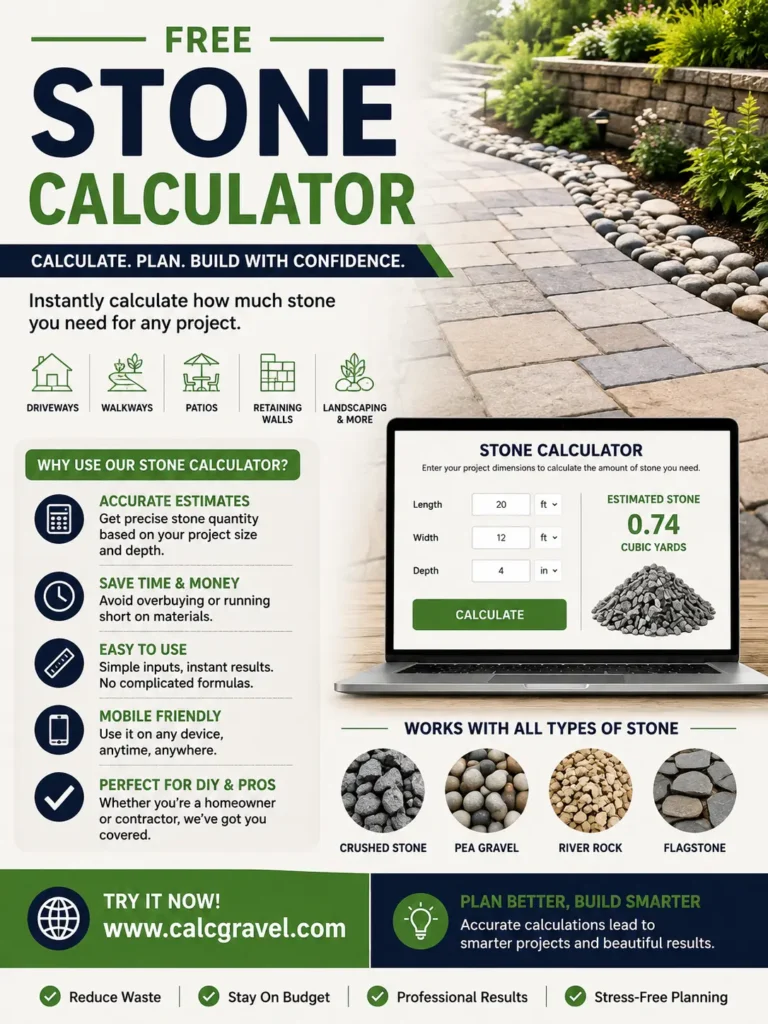
Ordering the right amount of stone is the difference between a clean, on-budget project and a driveway full of leftover gravel — or worse, a second delivery fee because you came up short. Our stone calculator takes your measurements and converts them instantly into cubic yards and tons, using real material densities instead of rough guesswork.
Whether you’re pricing out a landscape stone calculator job for a garden bed, a driveway stone calculator estimate for a new driveway, or a base rock calculator figure for a paver patio sub-base, this guide walks through the exact math the tool uses so you can double-check every number yourself.
How to Calculate Stone for Your Landscaping Project
Every accurate rock calculator or stone calculator for landscaping follows the same three-step logic: measure the area, turn that area into a volume, then convert the volume into a weight. Skip any one of these steps and your order will be off.
This is exactly the logic our stone calculator runs behind the scenes, so you can trust the output even if you never touch the formulas yourself.
Step 1 — Measure the Area (Square, Rectangular, Circular & Triangular Spaces)
Start by measuring your project space in feet, since every formula below assumes feet as the base unit.
- Rectangular or square areas: Length (ft) × Width (ft) = square footage.
- Circular areas: π × radius² (radius is half the diameter), or diameter² × 0.7854.
- Triangular areas: (Base × Height) ÷ 2.
- Irregular shapes: Break the space into smaller rectangles or triangles, calculate each one, then add the totals together — this is how a calculate rock for landscaping estimate stays accurate even on curved beds.
Step 2 — Calculate Volume in Cubic Yards
Once you know the square footage, multiply it by your required depth (converted from inches to feet by dividing by 12), then divide the result by 27 — the number of cubic feet in a cubic yard.
The 324 Rule (shortcut): Multiply your area in square feet by the depth in inches, then divide by 324. This single formula replaces the two-step conversion above and is the fastest way to run a yards of stone calculator estimate by hand.
Add a waste buffer before moving to Step 3: 10% for standard rectangular beds, and up to 15% for freeform or sloped areas.
Step 3 — Convert Cubic Yards to Tons
Because bulk suppliers price stone by weight, multiply your cubic yardage by the material’s density: Cubic Yards × Density (tons/yd³) = Total Tons Needed.
| Material Type | Tons per Cubic Yard |
|---|---|
| Crushed Stone | 1.4 – 1.5 |
| Gravel (¾” – 2″) | 1.4 |
| River Rock | 1.4 – 1.75 |
| Pea Gravel | 1.25 – 1.35 |
| Sand (Dry) | 1.35 – 1.5 |
| Lava Rock | 0.65 – 0.9 |
How Many Tons of Stone in a Cubic Yard?
As a rule of thumb, one cubic yard of crushed stone or gravel weighs about 1.4 tons (2,800 lbs), though the true figure ranges from 1.3 to 1.5 tons depending on stone size, gradation, and moisture. Materials with “fines” — like crusher run or road base — pack denser and weigh more per yard than clean, washed stone.
Wet sand or gravel can weigh noticeably more than the same material dry, so always confirm density with your supplier before a large order. Standard aggregate size classifications referenced throughout this guide follow ASTM D448 gradation numbers used industry-wide for crushed stone and gravel. For a full breakdown of yard-to-weight conversions across materials, see our internal cubic feet calculator.
Our stone calculator automatically applies the correct density for your selected material, so you don’t have to look these numbers up yourself.
How Many Yards of Stone Do You Need? (Coverage Chart by Depth)
This is where the 324 Rule pays off directly: one cubic yard of material covers 324 square feet at a 1-inch depth, and coverage drops proportionally as depth increases.
1″ Depth Coverage
Covers approximately 324 sq. ft. per cubic yard. Best suited to light top-ups of existing gravel where the base is already established — a 1-inch layer alone won’t fully hide landscape fabric.
2″ Depth Coverage
Covers approximately 162 sq. ft. per cubic yard (324 ÷ 2). This is the minimum depth most professionals recommend for decorative ground cover, garden paths, and borders where the goal is full weed-barrier coverage.
3″ Depth Coverage
Covers approximately 108 sq. ft. per cubic yard (324 ÷ 3). Considered the sweet spot for river rock and other decorative aggregates, giving a finished, walkable surface with strong weed suppression.
| Stone Depth | Coverage per Cubic Yard | Recommended Use |
|---|---|---|
| 1 inch | 324 sq. ft. | Light refreshes & top-dressing |
| 2 inches | 162 sq. ft. | Decorative beds & light paths |
| 3 inches | 108 sq. ft. | Walkways & standard landscaping |
| 4 inches | 81 sq. ft. | Patios & light driveway surfaces |
| 6 inches | 54 sq. ft. | Heavy-duty driveway bases |
Recommended Stone Depth for Different Projects
Depth requirements change based on whether the surface will carry foot traffic, vehicle weight, or neither.
- Decorative garden beds: 1–2 inches for basic ground cover; 2 inches minimum for full weed suppression.
- Walkways and garden paths: 2–3 inches for a stable, comfortable walking surface.
- Paver patio bases: 4–6 inches of compacted gravel plus 1 inch of bedding sand on top.
- Standard driveways: 4–6 inches of compacted base material.
- Heavy-duty or commercial driveways: 6–12 inches depending on vehicle load.
- French drains: 4–12 inches of clean washed stone, with at least 3 inches surrounding the pipe on all sides.
- Retaining wall backfill: a minimum of 12 inches of washed gravel behind the wall for proper drainage.
For a deeper breakdown of depth by material and project, see our gravel depth guide.
Types of Landscaping Stone & Rock (Which One to Choose)
Choosing the correct stone type affects both how the project performs and how it looks.
Crushed Stone vs Pea Gravel
Crushed stone is angular and interlocks when compacted, making it the stronger choice for driveways and high-traffic bases — #57 stone (½”–¾”) is a common driveway and drainage size, with a density of 1.4–1.7 tons per cubic yard. Pea gravel is small,
smooth, and rounded, so it stays loose underfoot; that makes it comfortable for paths and playgrounds but unsuitable for driveways, where it won’t hold a firm surface. See our full comparison in the pea gravel vs crushed stone guide.
River Rock vs Decorative Stone
River rock is smooth and water-worn, usually 1″–3″ or larger, and is the most popular pick for dry creek beds and garden borders, weighing 1.4–1.75 tons per cubic yard. Broader decorative stone options include lightweight, porous lava rock (0.65–0.9 tons/yd³), high-contrast marble chips, and hand-selected Mexican beach pebbles for premium accents.
Base Rock vs Landscape Stone
Base rock — road base, DGA, crusher run — contains stone dust (“fines”) that binds the material into a hard structural foundation, essential under patios, driveways, and concrete. Landscape stone is washed clean of fines so water drains freely between the pieces, making it the right choice for surface coverage, French drains, and retaining wall backfill rather than structural bases.
Stone Calculator for Driveway Base
How Much Base Rock Do You Need for a Driveway?
Driveway base calculations follow the same three-step process, but with a heavier compaction factor because base material must be pressed into a solid foundation.
- Measure the area: length × width in feet.
- Calculate volume: square footage × depth in feet ÷ 27 = cubic yards.
- Convert to tons: cubic yards × density. Dense-graded base materials typically run 1.5–1.9 tons per cubic yard, heavier than the 1.4-ton average for clean stone.
Worked example: A 50-ft by 10-ft driveway (500 sq ft) with a 4-inch compacted base:
- Volume: 500 sq ft × 0.33 ft = 165 cubic feet
- Yards: 165 ÷ 27 = 6.1 cubic yards
- Tons (at 1.5 density): 6.1 × 1.5 = 9.2 tons
- With a 20% compaction/waste allowance: approximately 11 tons total
Standard residential driveways need 4–6 inches of compacted material; heavy-duty or commercial driveways handling trucks or frequent traffic need 6–12 inches. Because loose base rock settles as air is pressed out, add a 15–30% compaction factor on top of your finished-depth calculation, plus a 10% waste buffer for spillage and uneven subgrade.
Lift-thickness and compaction guidance for aggregate base courses is consistent with standard state DOT construction specifications, such as the Florida LTAP roadway materials resources used for local and county road base work.
Estimated Stone Material Cost
Bulk material — sold by the ton or cubic yard — is almost always cheaper than bagged stone for anything beyond a small accent bed.
| Material | Approx. Cost per Ton (2026) |
|---|---|
| Road Base | $20 – $45 |
| Crushed Stone | $30 – $55 |
| Pea Gravel | $25 – $50 |
| River Rock | $40 – $85 |
| Masonry Sand | $20 – $40 |
Bagged 50 lb material generally runs $4–$12 per bag; it takes roughly fifty 40 lb bags to equal one ton, so bagged stone quickly becomes far more expensive on larger projects. Installed project costs also vary by scope — paver patios typically run $15–$45 per sq. ft. installed, and retaining walls $25–$90 per sq. ft. of face, depending on material and labor.
Delivery fees for loads under 5 tons can equal or exceed the material cost itself, and contractors commonly apply a 20–30% markup on materials for sourcing and logistics. Industry-wide aggregate pricing trends are also tracked by bodies such as the National Ready Mixed Concrete Association, which publishes broader material cost data for the construction sector. For a full 2026 pricing breakdown specific to landscaping stone, see our gravel cost per ton guide.
How to Account for Overage, Compaction & Waste
Ordering the exact mathematical volume almost always leaves you short, because site conditions and material behavior eat into your numbers.
- Compaction: add 10–15% for standard compacted bases, and 20–30% for heavy-duty, high-traffic applications. A 4-inch loose layer typically settles to about 3 inches once compacted.
- Waste and spillage: a flat 10% buffer covers most rectangular projects; increase to 15% for irregular, curved, or sloped beds.
- Subgrade loss: on soft or muddy ground, the first inch of stone often disappears into the soil before providing visible coverage — factor this “disappearing inch” into your total tonnage.
- Contingency: many contractors add an extra 5–10% for unexpected site conditions like buried debris or deep low spots.
When in doubt on a standard decorative project, a flat 10% addition to your total volume covers both settling and installation waste.
How to Lay Stone the Right Way (Prep & Installation Tips)
Getting the ordering math right only pays off if the installation is done correctly.
- Site prep: clear the area of sod and old material, excavate to the required depth, and grade slightly away from structures to prevent pooling.
- Edging and fabric: install borders before spreading stone, then lay a heavy-duty (3.1 oz+) landscape fabric with 6-inch overlapped seams to stop stone from sinking into the soil.
- Base and bedding: use base rock or crusher run — not clean washed stone — for any structural foundation, since the fines are what let it pack hard.
- Compact in lifts: spread and compact material in 4–6-inch lifts rather than dumping the full depth at once; aggregate compacts best at 6–12% moisture content.
- Finishing: spread with a bow rake for a uniform depth, then rinse with a hose to clear dust and bring out the stone’s natural color.
For a full step-by-step walkthrough, see our how to lay a gravel driveway guide.
Frequently Asked Questions
Do you buy stone by the yard or by the ton?
Most bulk suppliers sell heavy materials like landscape rock, gravel, and river rock by the ton, since weight is the most consistent way to price and haul dense material and trucks have set weight limits. Lighter materials such as mulch and topsoil are usually sold by the cubic yard instead. Small DIY jobs may also be sold by the yard or in individual bags.
How much area does one ton of stone cover?
As a rule of thumb, one ton of standard gravel covers about 100 sq. ft. at a 2-inch depth. A quick shortcut: divide 200 by your desired depth in inches to estimate square footage covered per ton.
| Depth | Coverage per Ton |
|---|---|
| 1″ | ≈ 200 sq. ft. |
| 2″ | ≈ 100 sq. ft. |
| 3″ | ≈ 80 sq. ft. |
| 4″ | ≈ 60 sq. ft. |
| 6″ | ≈ 40 sq. ft. |
What is the difference between stone and gravel?
Crushed stone is angular and interlocks when compacted, giving it superior grip for driveways and high-traffic bases. Gravel, like pea gravel, is typically smooth and rounded, so it stays loose and is more comfortable underfoot for paths and playgrounds. Materials with “fines,” such as road base or crusher run, act as a binder for structural foundations, while “clean” stone is washed to allow better drainage.
Whether you’re a homeowner tackling a weekend project or a contractor pricing out a job, this stone calculator takes the guesswork out of ordering material and helps you avoid both shortages and costly overorders.
Which stone is best for landscaping?
It depends on the goal: river rock suits natural garden beds and dry creek beds; pea gravel suits walking paths and decorative accents; lava rock works as a lightweight mulch alternative; boulders create focal points; and crushed stone is the right pick for driveways or any base layer where stability matters most.
Is a stone calculator accurate for irregular shapes?
Yes, as long as you break the space into smaller rectangles or triangles, calculate each section separately, and add the totals together. Because freeform beds with curves and slopes tend to need more material than the raw math suggests, it’s best to increase the waste buffer to 15% for these shapes.
How many cubic yards are in a ton of stone?
On average, one ton of standard gravel occupies about 0.71 cubic yards. Gravel (¼”–2″) typically yields 0.59–0.71 cubic yards per ton, larger rock (2″–6″) yields 0.71–0.91, and dry topsoil yields 0.77–1.0. Lightweight lava rock covers roughly twice the area of heavier stone per ton.
Related Calculators
- Gravel Calculator
- Cubic Feet Calculator
- Pea Gravel Calculator Guide
- French Drain Calculator
- Not sure where to source your gravel? Check our local gravel buying guide for pricing and delivery comparisons.
About / Sources & Methodology
Density figures, depth recommendations, and cost ranges in this guide reflect standard industry practice for aggregate and landscaping estimation, cross-checked across multiple supplier and contractor references. Material density can vary with moisture content and product type, so always confirm exact figures with your local supplier before placing a large order. Learn more about our editorial process on our About page.